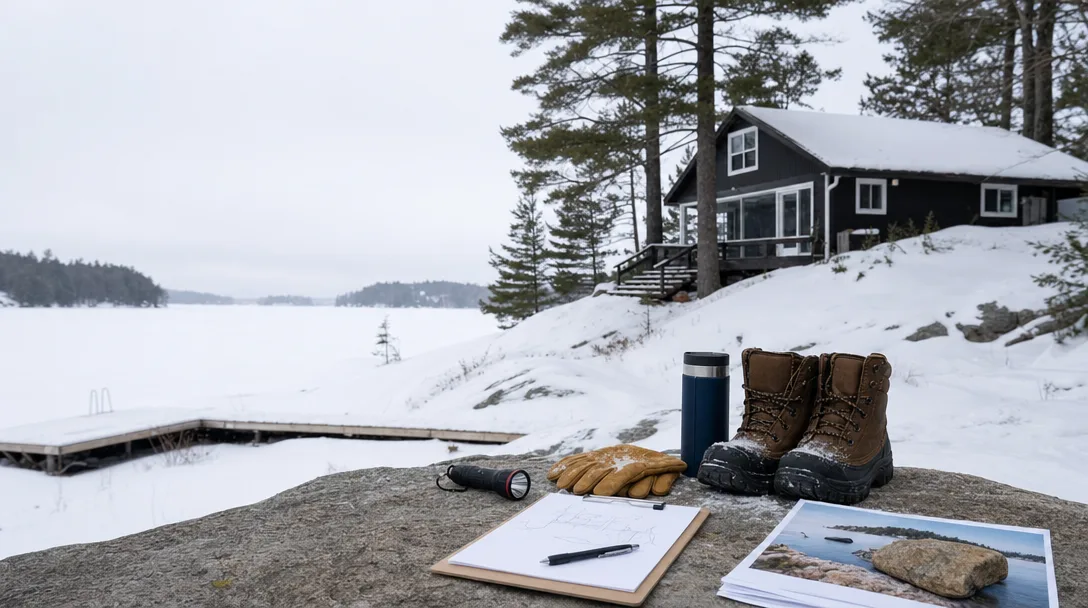
What should you check during a winter cottage viewing in Muskoka?
A winter cottage viewing in Muskoka confirms real cold-weather performance: driveway and road access after snowfall, heating efficiency, and insulation quality, while snow and ice conceal shoreline condition, septic access points, and dock footings. Treat the walkthrough as one input, then pair it with survey records, summer photos, and offer conditions before you remove them.
A January or February showing tells you things a summer tour cannot. You can watch how fast a plowed road clears after a storm, feel whether the cottage holds heat through a morning when Huntsville's January average daily temperature sits at -10.2°C, according to Environment and Climate Change Canada climate normals cited by Cottage Life Realty's guide to four-season cottages, and see whether pipes and water lines are protected rather than exposed to frost. Ontario Agent Search notes that cottage buyers should confirm whether heating, insulation, and plumbing are truly winterized for the climate, not assume a summer-built cottage can handle it.
What the same snow cover hides is just as real. Shoreline rock, erosion, dock footings, and septic access points sit under a layer of white that tells you nothing about summer condition. That gap is why a winter viewing works best alongside records, not instead of them.
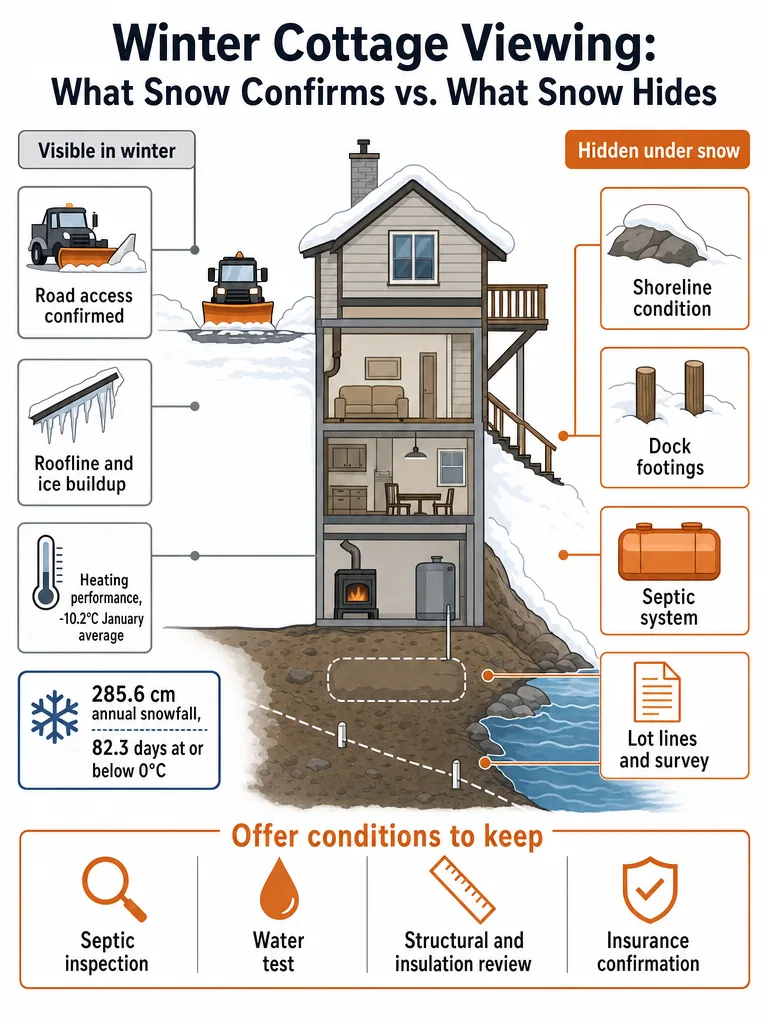
A January showing on a Lake of Bays cottage: what the snow showed and hid
On a winter Lake of Bays showing, snow can confirm access and heating performance, but it still hides shoreline condition, dock details, and lot-line clarity. That gap between what's visible on the walkthrough and what still needs verifying is the whole reason to treat a winter showing as one input, not the full picture.
Picture an illustrative scenario, not an actual listing: a three-bedroom cottage on Lake of Bays, shown on a January afternoon after an overnight snowfall. Huntsville averages 285.6 cm of snowfall across 54.4 snowfall days each winter, according to the climate normals cited by Cottage Life Realty, so a showing like this one is a realistic stress test rather than a worst case.
From the road, the driveway had been plowed to the door, and a fresh ridge along the shoulder showed recent clearing, a reasonable sign the private road gets regular winter attention. Inside, the cottage held heat through a cold morning, and the main floor felt warm within minutes of the furnace running. Icicles had formed along the eaves, a detail worth a closer look during a follow-up inspection rather than something to read into on sight.
Walking toward the water told a different story. The shoreline sat under packed snow and ice, so rock shelves, erosion, and the actual grade down to the lake were impossible to judge. The dock had been pulled for winter, leaving only footings visible above the ice, with no way to check their condition from a snowy site visit. Lot lines marked on an old survey couldn't be confirmed against a snow-covered boundary either.
For a cottage like this, the next calls matter more than the showing itself: a septic inspector to review the system beyond a pumping receipt, a well technician for a water test, and a surveyor to confirm the shoreline and lot lines once the ground is bare. A buyer who only saw the January showing would have confirmed heat and access. They still wouldn't know what the shoreline, dock, or boundaries actually look like underneath.
Is this cottage winterized, or only built for three-season use?
A winterized Muskoka cottage is built and equipped to function through the coldest months: continuous insulation, a heating system sized for the space, and plumbing protected from freezing. A three-season cottage is built for roughly May through October and is typically drained and closed before winter arrives. Listing language like "four-season" or "year-round ready" is not proof on its own.
Ontario Agent Search points out that some cottages are fully winterized while others are built for summer and need to be closed every fall, and the real test sits in the mechanical details, not the marketing copy.
| Feature | Winterized cottage | Three-season cottage |
|---|---|---|
| Insulation | Continuous, sized for winter cold | Partial or none, built for summer use |
| Heat source | Furnace, baseboard, or sized wood heat | Often none, or supplemental only |
| Water and plumbing | Protected from freezing, runs year-round | Drained and shut down before winter |
| Typical season of use | Year-round | Roughly May through October |
A cottage that looks winterized on paper can still fail if the plumbing isn't actually protected from freezing. Ontario Agent Search advises buyers to ask directly whether pipes are protected from freezing, and if there's a wood stove or fireplace, to get a WETT inspection from a trained wood energy technician before relying on the heating setup alone. For a full breakdown of how to tell the difference before you buy or sell, see winterized vs seasonal cottages in Muskoka.
Who plows the road, and is winter access secured in writing?
Road access in Muskoka falls into three categories, and winter plowing is guaranteed in only one of them. A township road gets municipal snow removal as a matter of course. A private road depends entirely on the arrangement the owners along it have set up, and a boat-access property may have no road at all for part of the year.
Ontario Agent Search advises buyers to find out whether a road is municipally maintained, privately maintained, or seasonal, and if it's private, how maintenance and snow removal are shared among the owners who use it. A verbal assurance from the seller that a neighbor plows the road is not a commitment that survives a change of ownership, a dispute, or a bad winter.
If no agreement exists, that's useful information on its own: you'd be negotiating a brand-new arrangement with neighbors you haven't met yet. For more on how access type affects what a property is worth, see what road access adds to Muskoka cottage value.
What can snow hide on the shoreline, dock, and septic system?
Snow and ice cover the three parts of a Muskoka waterfront property that matter most to long-term value: the shoreline, the dock or boathouse, and the septic field. A winter walkthrough alone can't confirm any of them, so the records have to do the work the site visit can't.
- A current survey. Ask for a recent survey showing the shoreline, setbacks, and lot lines rather than relying on an old plan that predates erosion or fill work.
- Summer shoreline photos. Request dated photos from a past season showing water depth off the dock, rock versus sand or weed bottom, and any visible erosion or retaining work.
- The septic permit and pump-out history. Ontario Agent Search is clear that a single pumping receipt doesn't tell you the system's age, type, or capacity; ask for the permit file and a service history, and build time for a professional inspection into your offer.
- Dock and boathouse permit files. Confirm what was actually permitted, since structures built without permits can limit what you're allowed to repair or rebuild later.
A winter showing is good evidence of heating and access. It is not a substitute for any of these four documents. If a seller can't produce them, treat that as a due-diligence issue and keep your conditions in place until it's resolved.
Buying a boat-access or water-access cottage in winter: how do you even view it?
Viewing a boat-access or water-access cottage in winter raises a different set of questions, because you can't simply drive to the door. Ontario Agent Search flags marina parking, docking, and how owners get to a water-access property during freeze-up or thaw as questions a buyer needs answered before counting on year-round use. Those two stretches, when ice is forming and when it's breaking up, are the periods when water access is most likely to be interrupted.
Confirm where owners park during the off-season, whether that parking is a deeded right or an informal marina arrangement, and what it costs. Ask whether the seller has a documented winter landing or ice-road arrangement, or whether winter access simply stops until the lake is safe. For the full cost picture on these properties, see water-access-only cottages in Muskoka.
What offer conditions protect you when snow hides the property?
Offer conditions are what protect a buyer from the parts of a property that snow hides. A tight winter closing timeline is not a reason to waive them. The structure below is a starting point to discuss with your lawyer and agent.
- Septic inspection condition. Time for a qualified inspector to assess the system, not just review a pumping receipt, with the deal conditional on the results.
- Water test condition. A professional test of well or lake-sourced water for quality and flow rate, since a frozen-over wellhead or intake can't be checked by sight in January.
- Structural and insulation review. A home inspector's assessment of the building envelope, roof, and any signs worth a closer look that were noticed during the winter showing.
- Insurance confirmation. Written word from an insurance broker that the property, including any wood stove, boathouse, or older septic system, is actually insurable before you commit, since an uninsurable cottage can unwind a deal at the last step.
Each condition should carry a defined number of days, agreed with your lawyer, rather than left open-ended. For a sense of what coverage and premiums look like once a policy is in place, see Muskoka cottage insurance cost.
Is winter actually a good time to buy a Muskoka cottage, or should you wait for spring?
Winter can be a genuinely good time to view and buy in Muskoka, and it can also be the wrong time, depending on what you're trying to confirm. Kristyn Kennedy's write-up on winter buying in Muskoka argues that the season brings less competition, more negotiating room, and a real test of how a cottage performs in actual cold weather, from driveway clearing to heating efficiency. Those advantages are real for a buyer focused on access and winterization.
The trade-off is what winter viewings can't show. If a property's value depends heavily on shoreline quality, dock condition, or lot-line clarity, a January walkthrough leaves gaps that only a survey, summer photos, and permit records can close, and gathering those takes time.
The decision usually comes down to how clear you already are on lake, access type, and budget before you start touring, not to the season on the calendar. Lining up those records and offer conditions ahead of a showing, rather than scrambling to assemble them after an offer is accepted, is what keeps a winter viewing from turning into a rushed decision.
Frequently asked questions
How do you choose a real estate salesperson for a winter cottage viewing in Muskoka?
Pick someone who lives in Muskoka year-round and can speak to specific lakes, road types, and septic systems, rather than an agent who only visits on weekends. Seth Drabinsky, a Real Estate Salesperson with CV Real Estate, Brokerage, works across Lake Muskoka, Lake Rosseau, Lake Joseph, and Lake of Bays and can schedule a winter showing in daylight hours so you can actually judge snow clearing and access before you tour.
Does a cottage with a wood stove need a WETT inspection before you buy?
Yes, a WETT inspection from a trained wood energy technician is the standard check before relying on a wood stove or fireplace as a heat source. Insurers typically require one before issuing or renewing a policy, so get the inspection done and the report in hand before you remove conditions, not after closing when a renewal or claim is on the line.
How much snow does the Huntsville area get in a typical winter, and why does that matter for a showing?
Huntsville averages 285.6 cm of snowfall across 54.4 snowfall days each winter, according to climate normals cited by Cottage Life Realty's guide to four-season cottages. That volume makes a showing after a fresh snowfall a realistic test of how quickly a driveway or private road actually gets plowed, rather than a rare worst-case you'd only see once a decade.
Why ask for summer shoreline photos if you're touring a cottage in winter?
Summer photos show water depth off the dock, whether the bottom is rock, sand, or weed, and any visible erosion or retaining work, none of which you can judge through snow and ice. A winter walkthrough confirms heating and access but tells you nothing about shoreline condition, so dated photos from a past season close a gap no January site visit can fill on its own.
Can a septic system and well be inspected in winter, or do you have to wait for spring?
A septic inspector and a well technician can generally test the system and water quality in winter, since that work does not depend on bare ground. Confirming the shoreline grade and lot lines against a survey does need snow-free ground, so build a surveyor into your offer conditions even if the septic and water tests go ahead right away.
What can make a Muskoka cottage uninsurable, and when should you find out?
A wood stove without a WETT inspection, a boathouse without permits, or an older septic system without service records can all make a cottage harder or impossible to insure. Get written confirmation from an insurance broker that the specific property is insurable before you remove conditions, since finding an insurance problem after closing leaves you with a cottage you can't finance or protect.