
Can You Rent Out a Cottage in Muskoka Lakes?
Buying a Muskoka cottage with rental income in mind means verifying six things before trusting the seller's numbers: that short-term rental is legal there, whether the licence transfers, whether septic capacity matches the advertised occupancy, real payout statements instead of projections, written rental insurance, and the actual legal rentable nights. Skip any one of these and the income a listing implies may not survive contact with the township.
Ontario has no single province-wide short-term rental law. Licensing, occupancy limits, and even the definition of a short-term rental vary by municipality, so a cottage on Lake Muskoka inside the Township of Muskoka Lakes answers to a different rulebook than a cottage on Fairy Lake inside the Town of Huntsville, even though both get called "Muskoka" in the same sentence.
The Township of Muskoka Lakes defines a short-term rental accommodation as temporary lodging for 28 consecutive calendar days or less, which covers the typical Airbnb or VRBO booking. Motels, bed and breakfasts, and similar commercial accommodations are excluded from that definition under the Township's Short Term Rental Accommodation Licensing By-law 2025-049. A licence from the Township is required before a rental of that length can legally happen.
Most of the licensing detail in this article is specific to the Township of Muskoka Lakes, where the available rules are the most completely documented. Huntsville and Gravenhurst run their own rental and tax structures, and other Muskoka-area municipalities may set different requirements that aren't covered in the same depth here, so confirm the current rules with the specific township before any rental number goes into your offer.
Does a Muskoka Lakes Short-Term Rental Licence Transfer When You Buy the Cottage?
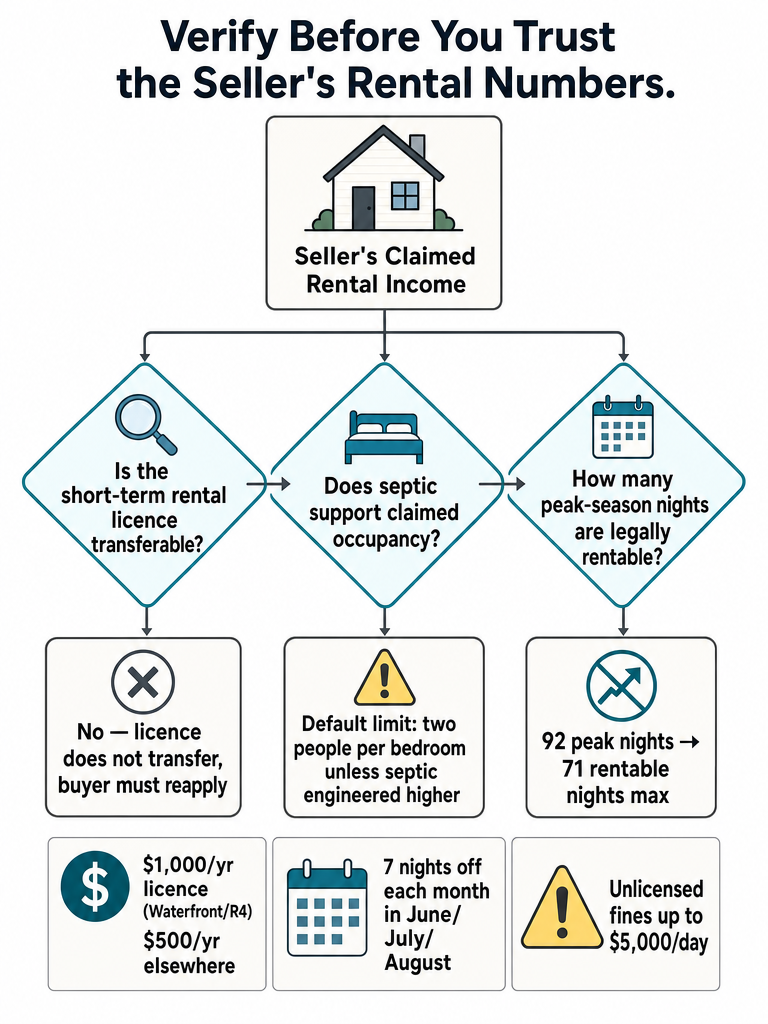
No. A Muskoka Lakes short-term rental licence cannot be transferred or assigned to a new owner under the Township's Short Term Rental Accommodation Licensing By-law 2025-049, approved April 16, 2025. Buying the cottage does not buy the licence; the next owner has to apply fresh, under whatever rules are in effect at closing.
That single fact undercuts a lot of seller pitches. A seller showing three years of booking history and strong occupancy is showing you a licence, a demerit record, and an operating history that stays with them, not with the cottage. You start over.
The licence costs $1,000 a year in Waterfront or R4 zones and $500 a year in all other zones, renewed annually. The Township sends a renewal notice 60 days before expiry, but even an unchanged renewal requires a fresh licensee acknowledgement, a renter's code of conduct, a responsible person declaration, and proof of insurance. A licence accumulates demerit points for violations, and 15 demerit points within three years suspends it. Operating or advertising a rental without a valid licence can bring fines of up to $5,000 per day.
This applies inside villages like Port Carling, which sits within the Township of Muskoka Lakes and follows its rental by-law rather than a separate village rule.
How Many Guests Can the Cottage Legally Sleep for Rental Use?
Two people per bedroom is the default occupancy limit for short-term rentals in the Township of Muskoka Lakes. A cottage can only house more guests if the sewage disposal system was designed and built to the Ontario Building Code for that higher occupancy, which the owner has to prove with permits rather than beds alone.
That turns the septic system into a financial question before it's a maintenance one. A five-bedroom cottage marketed as sleeping ten guests, with bunk rooms and pullout couches stacked on top of five bedrooms, may be running on a septic bed engineered for a smaller household. If the system was never upgraded or permitted for that occupancy, the township can hold the rental to the lower, bedroom-based number regardless of what the listing photos show.
Get the septic records and any Ontario Building Code permit tied to occupancy before you finalize a purchase built around a specific guest count. Without that paperwork, the number you can legally rent to may be lower than the number the seller has been renting to.
What Do Muskoka Lakes' Summer Turnover Rules Cost You in Rentable Nights?
Muskoka Lakes waterfront, R4, and Waterbody Open Space properties lose at least 21 nights of peak summer rental inventory to mandatory time off, which drops the 92 nights in June, July, and August to no more than 71 rentable nights. These rules took effect May 1, 2026, on top of the licence itself.
From the Friday before Victoria Day through the Tuesday after Labour Day, a waterfront, R4, or Waterbody Open Space property can host only one rental group per six consecutive nights. The owner must also take seven consecutive nights off in each of June, July, and August, and that break cannot straddle two months.
| Rule | What it limits | When it applies |
|---|---|---|
| One rental group per 6 consecutive nights | Turnover frequency in peak season | Friday before Victoria Day to Tuesday after Labour Day |
| 7 consecutive nights off, each month | Forces a mandatory gap | June, July, August |
| Combined effect | At most 71 of 92 summer nights rentable | June through August, waterfront/R4/WOS zones |
A seller's calendar showing back-to-back June-through-August bookings on a waterfront Muskoka Lakes property is either pre-dating the May 2026 rules, operating outside them, or describing a different zone. Any of those should prompt a direct question before you rely on the number.
What Should You Ask the Seller to Prove Before You Trust Their Rental Numbers?
Verify five things before any seller rental figure goes into your offer: the licence number, the demerit history, the septic permit and its design occupancy, actual payout statements instead of projections, and written clarity on whether the licence carries over. A seller's gross-season total means little without these behind it.
- Ask for the current licence number. For Muskoka Lakes properties, confirm it directly with the Township rather than taking the seller's word for it. A licensed operator must display the number in every advertisement, so you can cross-check it against the listing yourself.
- Request the demerit history. Demerit history is a compliance signal, not a guarantee about your own future licence. It shows whether the property has a record of violations, which is worth knowing even though the licence itself does not pass to you at closing.
- Get the septic permit and its stated design occupancy. If the system supports fewer guests than the booking calendar implies, the seller's revenue was generated on occupancy you may not be able to repeat.
- Ask for actual booking-platform payout statements, not a projection or a "comparable property" estimate. A real payout history shows nightly rate, occupancy, and platform fees already deducted.
- For Muskoka Lakes properties, get written confirmation from the Township on what happens to the licence at sale. Under Short Term Rental Accommodation Licensing By-law 2025-049, the existing licence does not transfer, so you'll need to apply fresh after closing, under whatever rules exist at that time. For properties in other municipalities, confirm the equivalent process with that township directly.
None of this is exotic paperwork. It's the same discipline buyers already apply when buying a cottage in Muskoka without costly mistakes: verify before you rely, not after you own it.
Will Your Cottage Insurance Cover Paying Guests?
Not automatically. A standard cottage insurance policy typically excludes paying guests, and an undeclared short-term rental can lead to a denied claim when something actually goes wrong. Rental use carries a different risk profile than personal use, and insurers price it, or exclude it, accordingly.
This matters most right after closing, when a buyer inherits a seller's rental plan but not the seller's insurance policy. Whatever coverage the seller had in place, if it even included rental use, doesn't transfer with the property any more than the short-term rental licence does. You need your own policy, written to cover guests who are paying to stay there.
Rental use, access type, and distance to a fire hall all move premiums, and checking Muskoka cottage insurance cost against your specific property is worth doing before you lock in a purchase price that assumes a certain net return.
Do Access, Water Supply, and Shoreline Ownership Limit How Much You Can Rent?
Yes. Road access type, water supply, winterization, and shoreline ownership all shape what guests will pay for and what the owner spends to keep the place rentable. A township-road cottage with a drilled well and full winterization appeals to a wider renter pool and carries lower plowing and access costs than a boat-access cottage on lake water, and a seller's rental projection built on one access type doesn't hold on another.
Boat-access-only and water-access-only cottages change the cost side of the rental math: insurance, plowing arrangements, and routine upkeep all cost more or work differently than they do on a township road, and these costs can sit outside a seller's seasonal income projection entirely. A three-season cottage also caps the rental calendar to the warm months, while a winterized cottage can theoretically rent outside the summer licensing window, subject to the same township rules.
Shoreline ownership matters too. In parts of Muskoka, the shore road allowance between the lot and the water's edge can still belong to the municipality rather than the owner, even where a dock, boathouse, or part of the cottage sits on it. Guests expect to use the dock and shoreline freely; if the owner's rights there are unclear, that's a liability question as much as a rental one.
Before you build a rental case around a specific cottage, evaluate the shoreline quality and the access type together, not separately.
What Happens to the Seller's Rental Math Once You Subtract Licensing, Taxes, and Forced Vacancy?
A seller's best-season gross number isn't a net figure, and the gap between the two is where rental math breaks down. One market analysis of Muskoka cottage rental income cites gross seasonal totals ranging roughly between $25,000 and $150,000, depending on lake tier, size, and amenities, with top waterfront properties on Lake Muskoka, Lake Rosseau, or Lake Joseph at the upper end. That range describes gross bookings, before a single cost comes off.
Start subtracting. The licence itself runs $1,000 a year in Waterfront or R4 zones in Muskoka Lakes, or $500 elsewhere in that township. If the cottage sits in Huntsville or Gravenhurst instead, both municipalities levy a 4% Municipal Accommodation Tax on stays under 30 days, on top of whatever licensing each of those towns requires for the rental itself. Add cleaning between every turnover, plus management fees if you're not running bookings yourself.
Then subtract nights, not just dollars. On a waterfront Muskoka Lakes property, the mandatory nights-off rule caps peak summer to at most 71 of 92 rentable nights, so a projection built on back-to-back June-through-August occupancy is already overstating inventory before fees are considered.
A seller quoting a single gross-season number is quoting the easiest number to make look good. Rebuild it with the licence fee, the applicable tax, cleaning and management costs, and the actual legal nights available under current rules, then compare that net figure against current Muskoka cottage prices without assuming any rental income at all.
Can Rental Income Help You Qualify for a Cottage Mortgage?
Possibly, but current sources don't establish how Canadian lenders treat projected short-term rental income on a Muskoka cottage purchase. Public, lender-specific underwriting standards for this situation are limited as of this writing, and treating any rental-income assumption as confirmed financing before your lender puts it in writing is a mistake.
Whether a lender counts rental income at all, and how much weight it gives it, varies by institution and by file. That means the seller's booking calendar, however convincing, is not something you can assume your mortgage approval will reflect.
Before you write an offer that depends on rental income covering part of the carrying cost, call your lender and ask directly what they'll count toward qualification, and under what proof. A pre-approval based on your income alone, with any rental income treated as a bonus rather than a requirement, protects you if the number doesn't hold up the way the seller's listing suggested it would.
Frequently asked questions
How much does a short-term rental licence cost in Muskoka Lakes?
A Muskoka Lakes short-term rental licence costs $1,000 a year on Waterfront or R4-zoned property and $500 a year everywhere else in the township, under the Short Term Rental Accommodation Licensing By-law 2025-049. The licence renews annually, with the Township sending a notice 60 days before expiry, and every renewal still requires a fresh licensee acknowledgement, renter's code of conduct, and proof of insurance.
What happens if you rent out a cottage in Muskoka Lakes without a licence?
Operating or advertising a short-term rental in Muskoka Lakes without a valid licence can bring fines of up to $5,000 per day under By-law 2025-049. The penalty applies to advertising the rental, not just hosting guests, so a listing posted before a licence is issued already carries exposure. Buyers taking over a seller's booking calendar should confirm the licence is active before the first guest checks in.
Can the Township suspend a short-term rental licence for violations?
Yes. A Muskoka Lakes short-term rental licence accumulates demerit points for violations, and 15 demerit points within three years suspends it under By-law 2025-049. Because the licence itself does not transfer at sale, a buyer inherits none of a seller's demerit history, good or bad, and starts the new application with a clean record regardless of how the previous owner operated the property.
Do Huntsville and Gravenhurst charge extra tax on cottage rentals?
Yes. Huntsville and Gravenhurst both levy a 4% Municipal Accommodation Tax on stays under 30 days, charged on top of whatever short-term rental licensing each town separately requires. That tax sits outside the Muskoka Lakes licensing structure entirely, so a cottage in either town runs a different cost stack than one inside the Township of Muskoka Lakes, and a seller's net numbers should reflect it.
What's a realistic gross rental income range for a Muskoka cottage?
Gross seasonal rental income on a Muskoka cottage has been reported to range roughly between $25,000 and $150,000, depending on lake tier, property size, and amenities, with top waterfront properties on Lake Muskoka, Lake Rosseau, or Lake Joseph at the upper end. That figure describes gross bookings before licensing fees, taxes, cleaning, and mandatory nights-off rules reduce it to a net number.
Does boat access reduce a cottage's rental income potential?
Often, yes. Boat-access-only cottages carry different and typically higher insurance, plowing, and upkeep costs than township-road properties, and those costs can sit outside a seller's seasonal income projection entirely. A township-road cottage with a drilled well and full winterization usually appeals to a wider pool of renters, so access type alone can make an otherwise comparable seller's rental projection fall apart on a different property.