What does water-access-only actually mean in Muskoka?
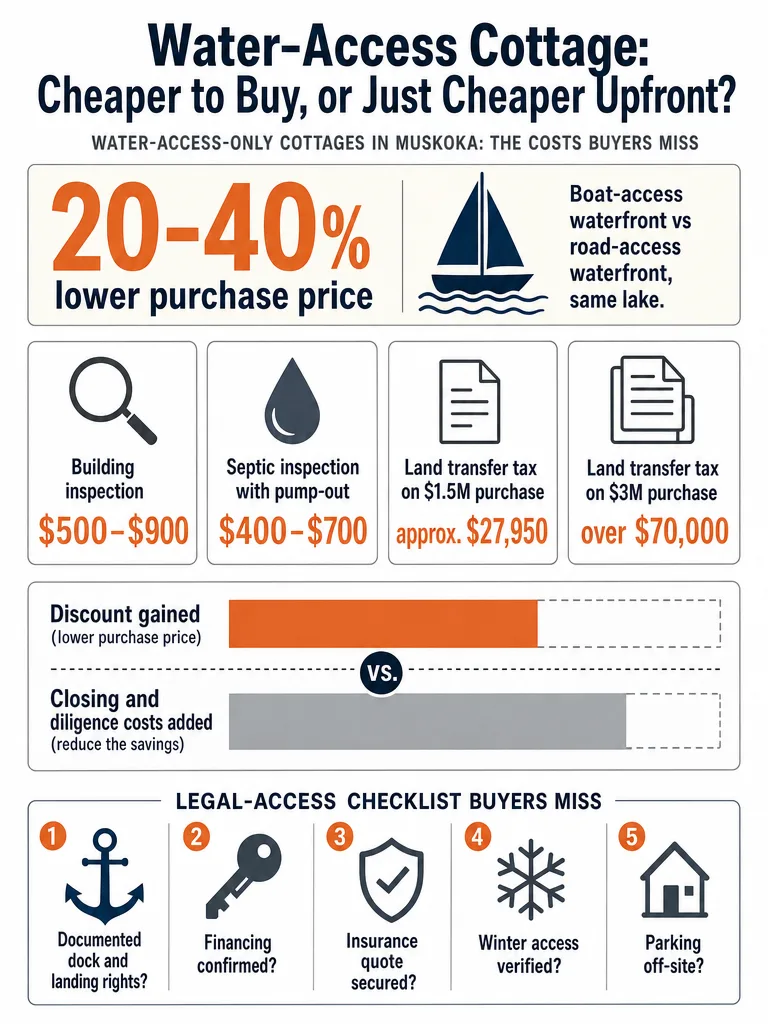
Water-access-only cottages in Muskoka can sell for less than road-access waterfront, but buyers still face the same Ontario land transfer tax, plus extra title review, inspection logistics, insurance and financing friction, service coordination, and winter-access limits that a lower price doesn't erase. CV Real Estate, a Muskoka brokerage, puts that purchase-price discount at 20% to 40% below comparable road-access waterfront on the same lake.
Water-access-only means there's no year-round motor vehicle route to the cottage door; you get there by boat, or by snowmobile once ice is confirmed safe. The category covers most islands, some peninsulas that never got road frontage, and a handful of mainland parcels where the real driveway and parking sit on a separate landing property down the shore. Lake Rosseau carries a lot of this kind of inventory around Port Carling and Windermere, next to stretches of straightforward road access on Lake Muskoka.
That CV Real Estate discount is the first thing most buyers notice and the last thing they fully understand. The gap exists partly because the buyer pool shrinks: fewer lenders and insurers quote without extra conditions attached, and fewer buyers are comfortable with a boat as their only driveway. That doesn't make water access a bad choice. It makes it a different kind of ownership, with different homework, before you decide the discount is worth it for how you plan to use the place.
Island cottage vs mainland water-access: why the difference matters
A true island cottage and a mainland water-access cottage both get labeled "water access only" in a listing, but they create different ownership experiences. An island cottage, common around Lake Rosseau, has no connection to any road at all; everything from the mailbox to the generator arrives by boat, full stop. A mainland water-access property is different: the building sits on the mainland, but its legal parking, dock, or landing is on a separate piece of land down the shore, sometimes shared with other owners, sometimes a private spot held under separate title.
That distinction matters more than listing photos suggest. A mainland parcel near Lake Vernon, part of the Huntsville chain that connects to Fairy Lake, Pen Lake, and Mary Lake, shows how this plays out. A 2026 listing for that property on the real estate site Square Yards describes more than 200 miles of connected boating across those four lakes, a genuine selling point that says nothing about whether the parking and landing rights tied to the cottage are actually documented or just informal. Ask which scenario you're buying before you compare the price to a road-access cottage on the same lake.
Are water-access cottages actually cheaper once you add up carrying costs?
A 20% to 40% discount on a multi-million-dollar cottage looks like real savings, but closing and diligence costs apply whether or not you drive to the door, and some of those costs run higher on water-access properties because inspectors, contractors, and lawyers need more time and more trips. CV Real Estate's cost breakdown for Muskoka cottage buyers is a useful starting point for what to budget beyond the purchase price itself.
| Cost item | Typical range | Water-access difference |
|---|---|---|
| Building inspection | $500 to $900 | Often takes longer; inspector travel by boat adds time |
| Septic inspection with pump-out | $400 to $700 | Same range, but scheduling can push out |
| Ontario Land Transfer Tax, $1.5M purchase | About $27,950 | Identical; tax is based on price, not access |
| Ontario Land Transfer Tax, $3M purchase | Over $70,000 | Identical |
| Legal and closing fees | Varies by firm | Can run higher with title review of landing and dock rights |
Source: CV Real Estate's cost guide for Muskoka cottage buyers.
A 20% to 40% purchase-price discount on a water-access cottage, as estimated by CV Real Estate, doesn't erase closing and diligence costs, which apply at the same rate regardless of access. The land transfer tax figures above come from that same CV Real Estate guide. Where water access quietly eats into the discount is inspections and legal review: a building inspector arranging a boat ride, or a lawyer confirming a landing arrangement on top of a standard title search. Septic servicing and other site work also typically need boat or barge coordination rather than a straight driveway visit, which can add time and cost; the available sources don't give current local pricing or scheduling specifics for that coordination. None of this is exotic, but it adds real days and dollars a straight price comparison misses. For a full line-by-line closing budget, see Muskoka cottage closing costs: what buyers should budget for.
Do you actually own the dock and shoreline on a water-access cottage?
Owning the cottage does not automatically mean you own everything between the building and open water. Shore road allowance, water lot ownership, and the exact location of the dock all need confirmation through title and survey review, not assumption, according to Treadstone Law's guide to buying a water-access-only cottage in Ontario. This matters more on water-access properties because the dock often functions as the entire legal access point, not a lifestyle extra.
In many Muskoka municipalities, the strip of land between a cottage and the water was historically reserved as a shore road allowance held by the township or the Crown, and it stays that way unless it has been formally stopped up and closed. If that process never happened on a specific property, the owner may not hold clear title to the shoreline their dock sits on. The same applies to any offsite landing, parking spot, or boat launch that isn't on the cottage's own deeded lot: Treadstone Law notes this kind of arrangement needs the same legal scrutiny as a right-of-way, not the assumption that it's simply understood between neighbors.
For a broader look at reading shoreline on a showing, see how to evaluate shoreline quality on a Muskoka cottage.
Can you get a mortgage on a water-access-only cottage in Muskoka?
Lenders generally treat boat-only access as a risk factor, not an automatic dealbreaker. Treadstone Law's guide to buying a water-access-only cottage in Ontario notes that unconventional access, meaning no year-round road and dependence on boat access, affects how lenders view resale liquidity, which can translate into fewer financing options, a larger down payment requirement, or extra documentation compared to a standard road-access purchase.
What the current research does not support is a specific list of which lenders will or won't finance a given island or mainland water-access property, or exact down payment percentages for this access type right now. That detail changes by lender, by property, and by file, and it isn't something to estimate from general knowledge. The practical move is to get financing pre-approval, or ideally a firm commitment, in writing before removing any conditions on an offer, and to tell your mortgage broker up front that the property is water-access-only rather than letting it surface during underwriting. A cottage you can't close because financing fell through at the last stage costs far more than the time it takes to confirm terms early.
Is it harder to insure a water-access-only cottage?
Insurance can be harder to secure, pricier, or both. Insurers weigh how quickly emergency services, especially fire response, can reach a property, and a boat-only location changes that math compared to a cottage on a plowed township road, according to Treadstone Law's guide to Ontario water-access cottage purchases. Coverage availability, cost, and terms can all move based on that access assessment.
That doesn't mean water-access cottages are uninsurable. It means the quote isn't a formality you can assume will land at the same number as a comparable road-access property. Get a firm, underwritten quote in hand, not a verbal estimate, before removing financing or inspection conditions on an offer. If a broker can only give a rough range until they see the actual access and dock setup, treat that as a reason to build extra time into your conditional period, not a reason to skip the step. For current budget ranges and what moves the price on a Muskoka policy, see Muskoka cottage insurance cost: what to budget.
How do groceries, propane, and septic service actually reach a water-access cottage?
Day-to-day logistics on a water-access cottage run through a boat trip, not a driveway, and heavier service jobs typically need boat or barge coordination rather than a truck. Almost everything that would be a quick drive on a road-access property becomes a planned water leg here, including deliveries, contractor visits, and waste removal.
- Everyday transport. Most owners use their own boat for groceries, guests, and routine trips, much like many Muskoka cottagers regardless of access type.
- Water taxis where available. Water taxis and private shuttle operators exist near some marinas, but hours, frequency, and cost vary by operator.
- Winter movement. Snowmobile or ATV access across the ice is possible but only once conditions are verified safe; it isn't a reliable substitute for a plowed road and shouldn't be planned around as one.
- Propane and bulk deliveries. Propane refills, building materials, and larger deliveries generally need water-based coordination with a supplier who services water-access properties. Boat or barge coordination can add time and cost, and the available sources don't give current local pricing or scheduling details for this.
- Septic service. Septic servicing on water-access cottages also needs to work around boat or barge access rather than a driveway visit, per Treadstone Law's guide to Ontario water-access cottage purchases. Exact workflows and turnaround times vary by property and provider, and current public detail on that is limited.
Buyers who already own a road-access cottage often underestimate how much planning this adds; it's less about any single trip and more about losing the option to call someone same-day. For the maintenance side of septic systems specifically, see addressing common septic issues in Muskoka cottages.
Can you count on using a water-access cottage in winter?
Winter use on a water-access cottage depends entirely on ice, and ice is not a schedule. Once the boat comes out of the water, access shifts to snowmobile or ATV travel across the lake, and only after conditions have been verified safe, which can mean stretches of the season where the cottage is effectively out of reach.
That's a bigger swing than most road-access owners deal with. A plowed township road might slow you down after a storm; an unverified ice route can close the cottage off until conditions improve, with no fixed timeline. Access type carries more weight here than it does on a road-access property, where winterizing the building and keeping the heat running are usually the main variables. If dependable four-season use matters to how you plan to own the cottage, that question needs to sit alongside the purchase-price discount, not behind it, when you're weighing a water-access property against a winterized cottage with road access. For a closer look at what dependable winter ownership requires beyond access, see winterized vs seasonal cottages in Muskoka: which fits you.
What should you verify before making an offer on a water-access-only cottage?
A water-access-only cottage needs a longer due-diligence list than a road-access property, because the access itself is the first thing that can go wrong after closing. The checklist below covers the items the research consistently flags as easy to assume and expensive to get wrong later.
- Confirm parking, dock, and landing rights on title. Don't rely on a seller's word that an arrangement is longstanding; have your lawyer verify it the way they'd verify a right-of-way.
- Confirm the shore road allowance status. Find out whether the strip between the cottage and the water has been formally stopped up and closed, or whether the township or Crown still holds it.
- Get a building inspection and a septic inspection with pump-out. Budget $500 to $900 for the building inspection and $400 to $700 for the septic inspection, per CV Real Estate's cost guide, and allow extra time for inspector access by boat.
- Get financing confirmed in writing, not just pre-approved in principle, with the lender aware from the start that the property is water-access-only.
- Get a firm insurance quote, not a verbal estimate, before removing conditions.
- Walk through realistic winter access for how you actually plan to use the cottage, not the best-case summer version in the listing photos.
Most of this detail doesn't show up in listing photos or the MLS description, which is why it's worth confirming directly with your lawyer, lender, and insurer rather than assuming it from the listing. For the fuller version of this process across any Muskoka cottage purchase, see how to buy a cottage in Muskoka without costly mistakes.
Frequently asked questions
How much cheaper are water-access-only cottages in Muskoka than road-access cottages on the same lake?
A water-access-only cottage in Muskoka typically sells for 20% to 40% less than a comparable road-access cottage on the same lake, according to CV Real Estate's cost guide. That gap exists partly because the buyer pool shrinks: fewer lenders and insurers quote without extra conditions attached. Land transfer tax, legal fees, and inspection costs still apply at the same rate, so the discount doesn't cover every added expense of owning a water-access property.
Do you pay the same land transfer tax on a water-access-only cottage as a road-access one?
Yes, Ontario land transfer tax is calculated on purchase price, not access type, so a water-access-only cottage costs the same as a road-access cottage at the same price point. On a $1.5 million purchase that works out to about $27,950, and a $3 million purchase runs over $70,000, per CV Real Estate's cost guide for Muskoka buyers. Closing and legal fees can run higher on water-access files because of extra title review for landing and dock rights.
Which Muskoka lakes have the most water-access-only cottages?
Lake Rosseau carries a large share of Muskoka's water-access-only inventory, especially around Port Carling and Windermere, where islands and peninsulas without road frontage are common. Lake Muskoka, by contrast, has mostly straightforward road access on the same stretches. Water-access cottages also show up as mainland parcels where the building sits on one lot and the parking or landing sits on a separate piece of land down the shore, sometimes shared with other owners.
Do you need to tell your mortgage broker that a cottage is water-access-only?
Yes, tell your mortgage broker that a cottage is water-access-only before you apply, not after. Lenders treat boat-only access as a risk factor because it affects resale liquidity, which can mean fewer financing options, a larger down payment, or extra documentation compared to a standard road-access purchase, according to Treadstone Law's guide to buying a water-access cottage in Ontario. Get financing confirmed in writing before removing any conditions on an offer.
Can you use a water taxi to reach a water-access cottage instead of your own boat?
Yes, water taxis and private shuttle operators run near some Muskoka marinas, but hours, frequency, and cost vary by operator and aren't guaranteed on demand. Most owners of water-access cottages still rely on their own boat for groceries, guests, and routine trips, the same way many cottagers get around regardless of access type. Treat a water taxi as a backup option for a specific trip, not as your primary transportation plan.
How much does a building and septic inspection cost on a water-access cottage in Muskoka?
Budget $500 to $900 for a building inspection and $400 to $700 for a septic inspection with pump-out on a Muskoka water-access cottage, per CV Real Estate's cost guide for buyers. Both typically take longer than on a road-access property because the inspector has to arrange boat travel and coordinate access with the seller. Build extra time into your conditional period so scheduling delays don't push against your closing date.