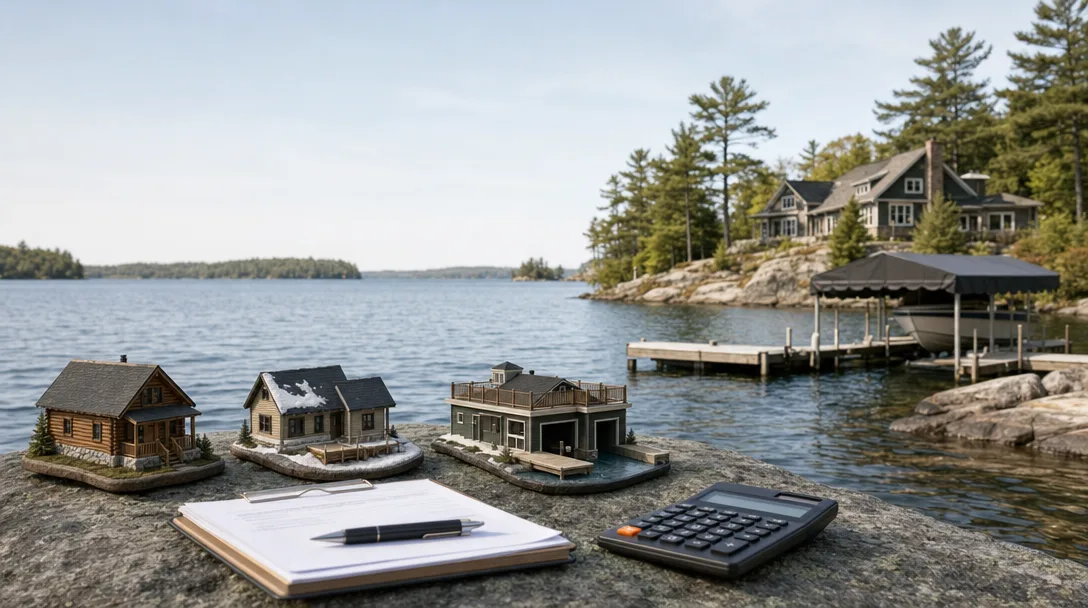
What does Muskoka cottage insurance cost?
Muskoka cottage insurance runs roughly $1,400 to $2,800 per year for 2026 regional averages, according to AccesDirect, which includes Bracebridge, Gravenhurst, and Huntsville. That sits inside the broader Ontario range of $800 to $3,000 per year, but Muskoka's waterfront and access risks tend to push premiums toward the higher half.
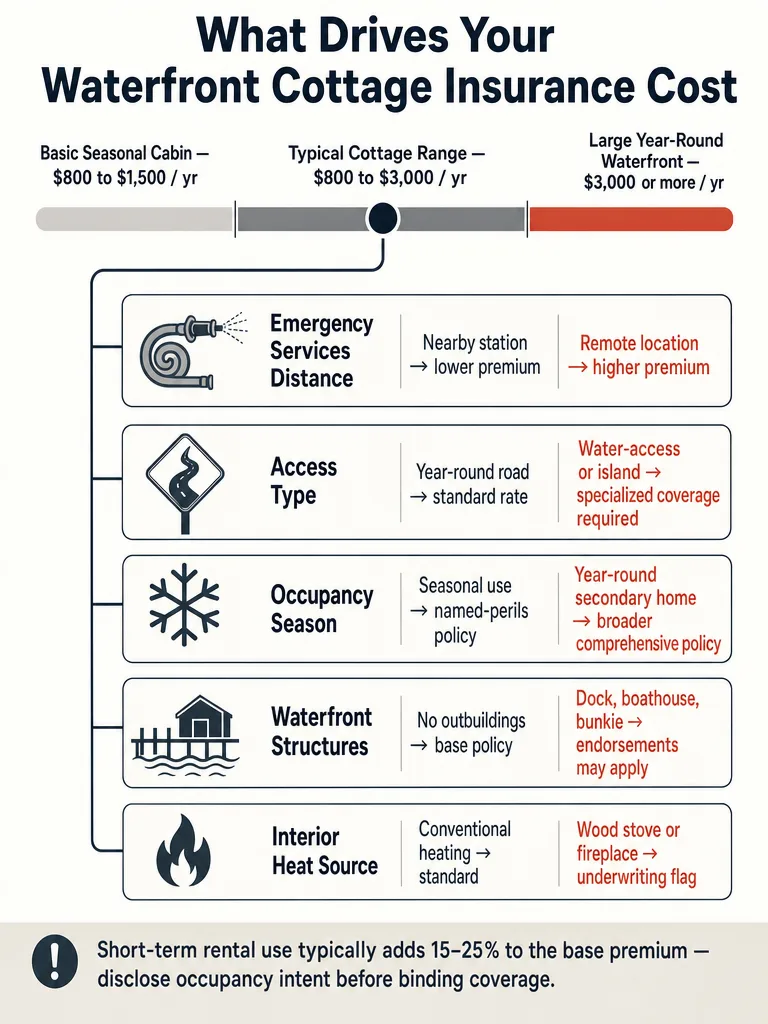
The number moves fast once you add features. Staebler Insurance says a basic seasonal cabin used only in summer can sit near $800 to $1,500 annually, while larger year-round properties with boathouses, docks, or high-value contents can climb to $3,000 or more.
Muskoka prices differently than the rest of Ontario because the listing photos rarely tell you what an underwriter will charge. Two cottages on the same bay can price hundreds of dollars apart based on winter access and how far the property is from a responding fire hall.
If you're weighing carrying costs before an offer, insurance belongs in the same budget line as closing costs and property tax. Treat the range above as a starting estimate, then get a quote tied to the actual address, access, and replacement value.
How much does cottage insurance cost in Ontario?
Cottage insurance in Ontario typically costs $800 to $3,000 per year, a range confirmed by both McLean & Dickey and Onlia. Where a property lands depends on type, location, and how often it's occupied.
Cottage insurance is a property policy built for seasonal or secondary dwellings that sit empty for stretches, covering the structure, outbuildings, contents, and liability.
The low and high ends split along predictable lines:
| Property profile | Typical annual cost | Source |
|---|---|---|
| Basic seasonal cabin, summer use only | $800 to $1,500 | Staebler Insurance |
| General Ontario range, all types | $800 to $3,000 | McLean & Dickey / Onlia |
| Year-round secondary home with boathouse, docks, high-value contents | $3,000 or more | Staebler Insurance |
Staebler also frames it monthly: estimates often fall between $150 and $250 per month, depending on coverage and property specifics. That monthly figure is a useful gut check when you're comparing listings and want a quick carrying-cost line.
What affects your cottage insurance cost in Ontario?
Underwriters price a cottage on risk, and the biggest variables are all things you can check in a listing before assuming a premium. InsureMyCottage.ca lists fire hall distance, road access versus water access, construction materials, wood-burning stoves or fireplaces, seasonal versus year-round occupancy, and the replacement value of the dwelling and outbuildings as the main drivers.
Distance to help matters most. Staebler notes a cottage far from fire stations or emergency services will likely cost more because remote properties carry higher risk. Volunteer fire response times across Muskoka vary widely, so two cottages ten minutes apart on the map can score very differently.
The factors that reliably move a Muskoka premium:
- Fire hall distance and hydrant access. Farther from a responding hall means higher risk pricing.
- Access type. Water-access or island-only properties price above year-round road access.
- Construction. Log homes can cost more to rebuild, which raises replacement cost.
- Heating. Wood stoves and fireplaces draw scrutiny; some insurers request WETT documentation.
- Occupancy. Seasonal use versus frequent year-round use changes the policy type available.
- Replacement value. The dwelling plus docks, boathouses, and bunkies all feed the number.
Onlia adds proximity to fire hydrants and the risk of water or fire damage to the same list. None of this is Muskoka-specific alone, but Muskoka concentrates all of it: remote lakes, older log construction, and wood heat are common here.
Winterized vs. seasonal cottage insurance: which policy type fits the listing?
Winterized versus seasonal is the classification that sets your price, and it follows how you'll use the property. McLean & Dickey explains that Ontario underwriting, guided by the Financial Services Regulatory Authority of Ontario (FSRA), examines accessibility and visit frequency to set your risk profile.
Seasonal properties are typically written on a named perils basis, covering specific listed risks like fire and theft, which keeps costs at the lower end. Year-round secondary homes with regular access and heating may qualify for broader comprehensive coverage, which covers more and costs more.
| Feature | Seasonal property | Secondary property |
|---|---|---|
| Usage | Summer use; closed or winterized in cold months | Frequent, year-round use including winter weekends |
| Road access | May be limited, unmaintained, water-access, or island | Municipal roads with year-round vehicle access |
| Occupancy threshold | Inhabited seasonally | Occupied at minimum 14 days a year (Onlia) |
| Coverage basis | Often named perils | May qualify for comprehensive |
Onlia sets the secondary-property bar at occupied at minimum 14 days a year, winterized, with year-round access. Its seasonal category is not winterized and usually inaccessible in winter due to unplowed roads.
This is the single most important classification question before you offer. If the listing says "four-season" but the road isn't plowed and there's no permanent heat, you may only qualify for named perils. Our guide on winterized vs. seasonal cottages in Muskoka and the breakdown of what road access adds to cottage value both matter here, because access drives the policy you can buy.
How much more will insurance likely cost on a water-access or island cottage on Lake Muskoka, Lake Rosseau, or Lake Joseph?
Water-access and island cottages generally cost more to insure because insurers treat remote access and slower emergency response as higher risk, though no source publishes a fixed surcharge. InsureMyCottage.ca states that island properties on Lake Muskoka, Lake Rosseau, and Lake Joseph typically require specialized coverage and should be discussed directly with a broker.
The mechanism is the same underwriting logic from earlier, concentrated. An island cottage sits farther from a responding fire hall, has no road for emergency crews, and often carries higher replacement value in the boathouse and dock. Staebler notes that year-round secondary homes with boathouses, docks, or high-value contents can reach $3,000 or more, and premium waterfront on the Big Three lakes stacks all three.
Because there's no published Muskoka water-access surcharge, treat island and boat-only listings as quote-first properties, where you confirm eligibility and price before you build a budget around them.
Where this bites buyers:
- Eligibility, not just price. Specialized coverage means fewer insurers will write it, so shop early.
- Replacement value climbs. A luxury boathouse on Lake Joseph can carry a rebuild cost that rivals the cottage.
- Emergency response is slower. No road access lengthens fire and repair timelines, which underwriters price in.
If you're comparing the premium lakes, our guides to Lake Joseph and Lake Rosseau cover how access and shoreline shape both value and carrying cost. Get an insurance quote on an island listing before you waive conditions, not after.
Are docks, boathouses, bunkies, and contents covered under the base policy?
Standard Ontario cottage policies commonly include the dwelling, detached outbuildings like bunkies and boathouses, docks, personal contents, and liability, according to McLean & Dickey. The catch for waterfront buyers is limits: several structures are covered only up to a cap unless you buy an endorsement.
AccesDirect says dock and boathouse coverage is often capped at 10% of the main building value unless increased by endorsement. That cap works fine for a modest cottage with a simple dock, but a two-storey boathouse on Lake Rosseau can easily exceed 10% of the dwelling value, leaving a gap.
What's typically included versus what may need attention:
| Feature | Base policy treatment | Watch for |
|---|---|---|
| Cottage structure | Covered at full replacement cost | Confirm replacement, not market value |
| Docks and boathouses | Often capped at 10% of main building value | Endorsement if value exceeds cap |
| Bunkies, outbuildings | Commonly covered | Confirm each structure is listed |
| Contents and recreational gear | Covered to a limit | Reflect year-round replacement cost |
| High-value items | Onlia caps at $2,500 | Schedule jewelry, art separately |
Onlia's high-value item coverage for valuables like jewelry and paintings applies up to a limit of $2,500, so anything above that needs to be scheduled. AccesDirect prices standalone dock coverage at $50 to $150 per year depending on insured value.
Can I list it on Airbnb without telling the insurer?
No. Renting the cottage changes its risk profile, and doing it without telling your insurer can void coverage on a claim. Staebler states that renting out a cottage on Airbnb or Vrbo shifts it into a commercial-use category and often requires specialized coverage, which raises rates.
The cost is quantifiable. AccesDirect says specific home-sharing coverage for rental or short-term rental use often adds 15 to 25 percent to the premium. On a Muskoka policy already sitting at $1,400 to $2,800, that's roughly $210 to $700 more per year.
If part of your buying math depends on rental income to offset carrying costs, price the rental endorsement into the plan from the start. Ask the broker whether the insurer allows short-term rental at all, since some won't write it, and confirm what documentation they want. Undisclosed rental use is the kind of gap that surfaces at the worst possible moment: after a claim.
What exclusions matter most for a Muskoka waterfront buyer?
The exclusions that matter most on a Muskoka waterfront property are overland flooding, wildlife damage, gradual or maintenance-related damage, vacancy-related vandalism, and frozen pipes during winter absences. McLean & Dickey names wildlife damage, overland flooding, and gradual or maintenance-related damage among standard exclusions.
Each translates into a specific waterfront risk:
- Overland flooding. Standard policies often exclude it; near a lake this is exactly the exposure you'd want, so ask whether it's available as an add-on.
- Wildlife damage. A property empty for weeks is vulnerable to animals getting in. Damage from wildlife is commonly excluded.
- Gradual and maintenance-related damage. Slow leaks, rot, and wear aren't covered. An older cottage with deferred maintenance carries real uninsured risk.
- Vacancy-related vandalism. McLean & Dickey notes extended vacancy increases the severity of damage from fire, vandalism, or weather because no one is on-site to respond.
- Frozen pipes. A burst pipe in a cottage left over winter is a classic Muskoka claim, and coverage often hinges on how the property was shut down.
This is where the cottage inspection and a look at septic condition pay off. What an inspector flags as maintenance is often exactly what an insurer won't cover later.
Does my primary home policy cover my cottage?
No. An ordinary homeowners policy is not built for the extended vacancy and localized risks a cottage faces. McLean & Dickey is direct on this: leaving a property unoccupied for weeks or months exposes it to risks standard home insurance isn't designed to handle, from a winter pipe burst to a storm-downed tree while you're back in the city.
That's why a separate cottage, seasonal, or secondary property policy is usually needed. The distinction becomes mandatory when financing is involved. McLean & Dickey notes that while Ontario doesn't legally require cottage insurance, virtually all Canadian banks and traditional lenders make comprehensive coverage a condition before releasing funds on a purchase or renovation.
For a first-time cottage buyer, budget the cottage policy as its own line, separate from your city home insurance. Assuming your existing policy stretches to cover the cottage is one of the surprises that catches new owners, right alongside hydro and property tax.
What are bundle options for cottage insurance in Ontario?
Bundling can lower the cost. Onlia says combining cottage insurance with its car and primary home insurance can save an extra 20 percent. That's a meaningful discount on a Muskoka premium sitting in the $1,400 to $2,800 range.
The savings are real, but they don't replace a property-specific quote. A bundle discount applies to whatever the underlying premium turns out to be, and that premium still reflects the same Muskoka variables: access, fire hall distance, replacement value, and use. A 20 percent discount on a policy that was underpriced because the boathouse cap was missed still leaves you underinsured.
Use bundling as a savings lever after you've confirmed the coverage is right. Get the cottage priced accurately for its access and structures first, then ask what bundling with your existing home and auto policies saves.
Pre-offer insurance checklist for Muskoka buyers comparing lakes and access
Before you offer on a cottage in Port Carling, Bracebridge, Gravenhurst, Huntsville, on Skeleton Lake, or the Big Three, confirm the insurance basics while you still have conditions to lean on. Insurance is where hidden access and maintenance issues turn into cost, so treat it as due diligence you finish before you sign.
Work through these before you sign:
- Confirm access type. Year-round road, seasonal road, or water/island access. This sets your policy category and price.
- Check fire hall distance. Farther from a responding hall means higher-risk pricing.
- Classify it correctly. Seasonal named-perils versus year-round secondary comprehensive, using the 14-day occupancy and winterization test.
- List every structure. Confirm the dock, boathouse, and bunkie are covered and whether they exceed the 10% cap.
- Declare rental plans. Short-term rental can add 15 to 25 percent and may not be allowed.
- Read the exclusions. Overland flood, wildlife, vacancy vandalism, frozen pipes.
- Gather wood-heat documentation. Some insurers request WETT paperwork on stoves and fireplaces.
- Insure to replacement cost. Full rebuild value, not market or purchase price.
For the wider picture, pair this with our guides on how to buy a cottage in Muskoka without costly mistakes and choosing the right lake by budget and lifestyle.
If you want a local read on how access, structures, and winter status will affect carrying costs on a specific listing, Drabinsky Realty can walk the property questions with you before you offer. Getting the access and insurance picture right early is cheaper than discovering it after conditions are waived.
Frequently asked questions
How much does Muskoka cottage insurance cost per year?
Muskoka cottage insurance runs $1,400 to $2,800 per year for 2026, according to AccesDirect — higher than the $800 Ontario baseline because waterfront access and distance from fire halls push premiums up. Basic seasonal cabins used only in summer can sit near $800 to $1,500 annually, while larger year-round properties with boathouses and docks can reach $3,000 or more.
What factors affect cottage insurance rates in Ontario?
Distance to the nearest fire hall is the biggest driver — remote properties cost more because emergency response is slower. Water-access or island-only listings price above road-accessible ones. Log construction, wood stoves or fireplaces, seasonal versus year-round occupancy, and the combined replacement value of the cottage, dock, boathouse, and bunkie all move the final number. In Muskoka, several of these stack on a single property.
Does a water-access or island cottage on Lake Muskoka, Lake Rosseau, or Lake Joseph cost more to insure?
Yes. Island and water-access properties on the Big Three lakes typically require specialized coverage because insurers price in slower emergency response and higher replacement value — especially for luxury boathouses. No published surcharge exists, so treat any boat-only listing as a quote-first property: confirm eligibility and price before building a budget around it.
What is the difference between seasonal and secondary cottage insurance in Ontario?
Seasonal policies cover summer-use properties on a named-perils basis (fire, theft), keeping costs lower. A secondary property policy applies when the cottage is occupied at minimum 14 days a year, winterized, and accessible by year-round road — it may qualify for broader comprehensive coverage, which covers more risks and costs more. If the road isn't plowed and there's no permanent heat, the listing isn't truly four-season regardless of what the ad says.
Are docks, boathouses, and bunkies covered under a standard cottage policy?
Standard Ontario cottage policies typically include docks, boathouses, and bunkies, but dock and boathouse coverage is often capped at 10% of the main building value unless you buy an endorsement. On a high-value Lake Rosseau or Lake Joseph property, a two-storey boathouse can easily exceed that cap. AccesDirect prices standalone dock coverage at $50 to $150 per year depending on insured value — confirm limits in writing before you close.
Does renting my Muskoka cottage on Airbnb affect my insurance?
It voids coverage if you don't disclose it. Short-term rental shifts the property into a commercial-use category, and AccesDirect says the specific home-sharing endorsement often adds 15 to 25 percent to the premium. On a Muskoka policy at $1,400 to $2,800, that's roughly $210 to $700 more per year. Some insurers won't write short-term rental at all, so confirm eligibility before you list.
Sources
- How Much is Cottage Insurance in Ontario?www.staebler.com
- Cottage Insurance Ontario | Coverage, Cost & Free Quoteswww.mcleananddickey.com
- Muskoka Cottage Ownership Costs (2026): Budget Guidewww.facebook.com
- Insurance for unique lakefront property? | Muskoka, ONwww.facebook.com
- What are bundle options for cottage insurance in Ontario?www.onlia.ca
- Protect Your Vacation Investment: Cottage Insurance 101insuremycottage.ca
- Muskoka Cottage Insurance | InsureMyCottage.cawww.accesdirect.com
- Cottage Insurance Ontario 2026: Muskoka, Kawartha, Seasonal Coveragewww.kristynkennedy.com