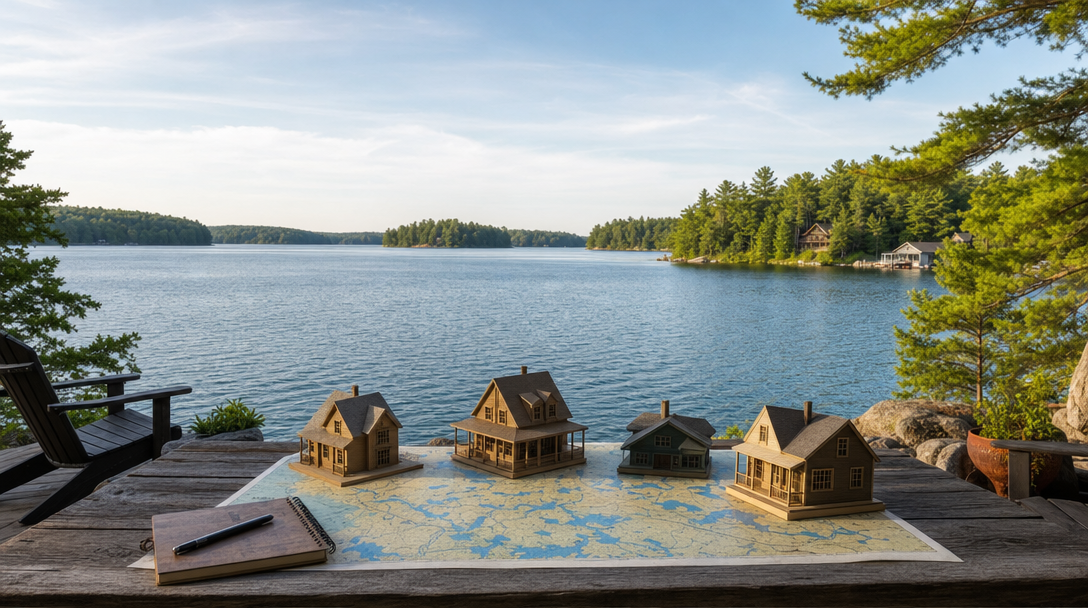
What are the Big Three lakes in Muskoka, and why do buyers treat them differently?
In Muskoka, the "Big Three" refers to Lake Muskoka, Lake Rosseau, and Lake Joseph — the region's largest, best-known, and most consistently premium-priced lakes. Buyers separate them from the rest of Muskoka because they are physically connected: the Indian River links Lake Muskoka to Lake Rosseau, and the cut at Port Sandfield connects Lake Rosseau to Lake Joseph. A boater can leave a dock on Lake Muskoka and tie up for lunch on Lake Joseph without ever trailering the boat (Source: Buy Muskoka).
Scale matters too. According to the Muskoka Watershed Council, as cited by Lakelands Real Estate, Lake Muskoka is the largest of the three at roughly 121 square kilometres, with Lake Rosseau at about 63.9 km² and Lake Joseph at about 54.6 km². Other sources cite Lake Muskoka at closer to 130 km² or 55,000 acres, so treat any single measurement as directional rather than definitive. What's not in dispute is the practical outcome: Lake Muskoka's scale supports more marinas, more cruising routes, and direct access by water to villages like Port Carling, Bala, and Windermere. The Muskoka Lakes Chamber highlights the Big Three alongside 77 other lakes in the area, so buyer options genuinely extend well beyond the famous three.
There is no single "best" lake in Muskoka — only the best fit for a buyer's budget, lifestyle, access needs, and long-term plans. A GTA family that wants Saturday-morning arrivals and busy marina life evaluates this decision very differently than a buyer looking for a quiet legacy estate to hold for 30 years. The rest of this guide works through that fit question lake by lake.
Big Three vs. smaller lakes in Muskoka: which fits your budget and lifestyle?
The Big Three give you connected-waterway cottage life, broad marina access, and the strongest resale demand. Smaller lakes give you quieter water, often better value per foot of frontage, and — depending on the lake — a different kind of cottage experience entirely. Neither is universally better.
Lakelands Real Estate notes that smaller and mid-size Muskoka lakes typically have fewer launches, less boating infrastructure, and less through-traffic, which many buyers actively want. Skeleton Lake, for example, is known as one of Muskoka's clearest and deepest lakes, with rocky elevated lots and limited public access — but you trade some services and a longer drive for that seclusion (Source: Cottage in Muskoka). Georgian Bay offers a completely different rhythm: open horizons, wind, granite outcrops, and winter access considerations that suit more adventurous buyers.
| Lake / Area | Typical buyer fit | Boat traffic | Services nearby | Trade-off |
|---|---|---|---|---|
| Lake Muskoka | GTA families, social cottage life, first Big Three purchase | Moderate to high | Gravenhurst, Bala, Port Carling | More activity, more environmental/flood nuance |
| Lake Rosseau | Prestige with village access | Moderate to high | Port Carling, Windermere, Rosseau | Premium pricing, less inventory |
| Lake Joseph | Privacy, legacy estates | Low to moderate | Port Sandfield, Hamer Bay | Scarcity, longest drive of the three |
| Lake of Bays | Scale without the Big Three label | Low to moderate | Dorset, Dwight, Baysville | Less polished, further from GTA |
| Skeleton Lake | Water quality, seclusion | Low | Limited | Fewer amenities, longer drives |
| Georgian Bay | Adventurous, big-water buyers | Variable | Parry Sound area | Navigation hazards, exposure |
| Huntsville / Bracebridge area | Year-round use, town access | Varies by lake | Full town amenities | Less "cottage" isolation |
Lake Muskoka vs. Rosseau vs. Joseph: what does $1M–$2M+ realistically buy?
In the $1M–$2M+ band, Lake Muskoka usually gives you the widest range of waterfront options, but you should expect compromises on at least one of condition, frontage, location, finish, or boat traffic (Source: Kristyn Kennedy). Lake Rosseau and Lake Joseph are scarcer and more premium, with Joseph especially tied to legacy ownership and privacy.
Buy Muskoka lists Lake Joseph's overall average price range at roughly $3M–$15M+ and Lake Rosseau at $2.5M–$12M+. Those are broad averages, not tiered inventory guarantees — but they tell you most of what you need to know about entry points. A buyer with a firm $1.5M ceiling is almost always looking at Lake Muskoka, a smaller lake, or an off-water property near one of the prestige lakes — not a turnkey Joseph estate.
| Budget band | What it typically accesses |
|---|---|
| $1M–$2M | Strongest fit on Lake Muskoka: entry-level waterfront, older cottages, compromise bays, or smaller frontage. Very limited on Rosseau; rare on Joseph (often older, smaller, or back-lot). |
| $2M–$3M+ | Better Lake Muskoka cottages with useable frontage and condition; entry-level waterfront begins to appear on Rosseau and Joseph. |
| Above Joseph/Rosseau averages | Core estate territory on Rosseau and Joseph; trophy properties on Lake Muskoka. |
A meaningful caveat: according to Finding Your Muskoka's long-term trends analysis, Lake Rosseau typically sees annual transactions in the low double digits, so one very high sale can noticeably shift the annual median. Treat headline "average price" numbers on Rosseau and Joseph as directional, not definitive.
For a deeper dive on how these two lakes stack up specifically, see our Lake Muskoka vs. Lake Rosseau buyer's guide and the broader Muskoka cottage prices outlook for 2026.
Which Muskoka lake is best for convenience, amenities, marinas, and GTA access?
For buyers who prioritize shorter Toronto drive times, marina services, family use, and a social cottage culture, Lake Muskoka is usually the strongest Big Three fit. Kristyn Kennedy's Big Three comparison puts Lake Muskoka at roughly 2–2.5 hours from Toronto versus 2.5–3 hours for Lake Rosseau — not a huge gap on paper, but meaningful when you are making that drive every Friday night with kids and groceries.
Lake Muskoka's geography also concentrates services. Gravenhurst and Muskoka Wharf anchor the south end with restaurants, the Segwun steamship, and a year-round town feel. Bala and Torrance sit on the west side with marinas, the Bala Falls area, and an easy Highway 400 approach. Port Carling — shared with Rosseau via the Indian River — offers groceries, marine services, shopping, and the locks that connect the system. Bracebridge sits at the northeast corner with full town amenities and hospital access.
That convenience has a cost: more boat traffic, more wake, and more activity on summer weekends. Cottage in Muskoka describes Lake Muskoka as the most mixed of the Big Three — marinas, resorts, steamships, wake boats, pontoons, cruisers, older estates, and modest camps all sharing the same water. Some buyers love that energy; others find it too busy and look to Joseph or a smaller lake.
Which Muskoka lake is best for privacy, exclusivity, and legacy ownership?
Lake Joseph is typically the right fit for buyers who want maximum privacy, lower boat traffic, ultra-luxury estates, and long-term legacy ownership. Buy Muskoka characterizes Lake Joseph as very private with low-to-moderate boat traffic, compared with Lake Rosseau's more active, social feel and moderate-to-high traffic.
Lake Joseph covers approximately 13,000 acres versus Lake Rosseau's roughly 9,100 acres, but the more important difference is how those acres are used (Source: Buy Muskoka). Joseph sees fewer day-trippers, less through-traffic, and a quieter shoreline culture, partly because there are fewer public access points and the lake sits further from the main highway corridor. Port Sandfield, the narrow cut between Rosseau and Joseph, is the practical gateway, and the JW Marriott area anchors the north end without dominating it.
Lake Rosseau is the middle path. You get prestige and substantial estates, but also village access to Port Carling, Windermere, and Rosseau village, plus a historically more social scene tied to prominent Toronto families. Beaumaris and Milford Bay on Lake Muskoka, for reference, offer some of that estate character on a different lake with different pricing.
Wondering which of the Big Three actually suits how your family will use the cottage? Talk to Seth for a grounded read on where your budget and lifestyle line up.
When is Lake of Bays a better fit than the Big Three?
Lake of Bays is a credible alternative when you want Muskoka scale and premium waterfront without the Big Three label or premium. Lake of Bays Realtors describes it as offering better value, more tranquility, and a stronger cottage-community feel than Rosseau or Joseph, with over 170 kilometres of shoreline to work with.
The lake anchors the eastern side of Muskoka, with Dorset at the top, Dwight on the north shore, and Baysville at the southwest outlet. Huntsville is the nearest full-service town, which means groceries, hospital access, and restaurants are genuinely close. Cottage in Muskoka describes the area as grand in scale but less polished than Rosseau or Joseph — more authentic cottage country, less manicured estate country.
Lake of Bays tends to suit buyers who:
- Want premium waterfront without paying Joseph premiums.
- Value paddling, swimming, and quieter boating over big-cruiser culture.
- Don't mind the extra driving time from the GTA (typically 30–45 minutes beyond the Big Three, depending on destination).
- Like a village scene anchored by Dorset, Dwight, and Baysville rather than Port Carling.
- Plan to use the cottage heavily and want a community feel rather than a social scene.
It is not a substitute for the Big Three in terms of name recognition or connected-boating access, and that matters for some buyers. For others, it is exactly the point.
How should buyers evaluate a specific waterfront lot beyond the lake name?
Once you've narrowed the lake, the individual lot matters more than the lake name. Two properties on the same bay can have completely different lifestyle and resale profiles based on shoreline, exposure, and access. A 2026 spring buying guide from Laura In Muskoka identifies shoreline type, sun exposure, water depth, privacy, topography, water quality, boat access versus road access, and distance from home as the waterfront factors buyers should evaluate before offering.
Practical checklist when you tour a lot:
- Frontage and useability. Total frontage is less important than how much of it is actually useable — gentle entry, swimmable depth, dockable water.
- Shoreline type. Sandy walk-in is family-friendly but rarer and priced accordingly. Rocky shoreline is classic Muskoka and often deeper at the dock. Weedy or shallow shorelines can limit swimming and boating.
- Sun exposure. Western exposure gives you sunset dinners on the dock; eastern gives you morning sun and cooler afternoons. Southern is generally most valuable; northern can feel dark.
- Topography. A flat walk to the water is rare and commands a premium. Steep lots mean stairs, retaining walls, and accessibility questions as owners age.
- Privacy. How close is the neighbour's dock? What do you see from your own dock looking across? Winter views (no leaves) tell the real story.
- Road access vs. boat access. Boat-access-only properties can be significantly cheaper but dramatically change how you use the cottage, especially shoulder season.
- Winter maintenance. Who plows the road? Is the driveway useable in February? Four-season plans need four-season access.
- Septic and services. Older systems near the shoreline are a significant liability — see our guide on common septic issues in Muskoka cottages.
- Water depth at the dock. Critical for bigger boats and for kids jumping off the end of the dock.
For a full pre-offer walkthrough, our cottage inspection essentials guide covers the systems checks that matter most, and the waterfront vs. off-water comparison helps if you are still weighing that tradeoff. First-time buyers should also review our 10 essential tips for first-time Muskoka cottage buyers.
How do flooding risk, scarcity, and transaction volume affect price and resale?
Lake-specific risk and sales volume shape both pricing and resale in ways most buyers underestimate. On Lake Muskoka, Cottage in Muskoka flags greater environmental and flooding realities in low-lying areas such as Bala Bay and near Bala Falls — something to verify carefully on any specific property, especially if there is a low boathouse or a shoreline structure near historical high-water marks.
Transaction volume matters for a different reason. According to Finding Your Muskoka's long-term trends analysis, Lake Muskoka adjusts first and most visibly when buyer behaviour shifts, particularly below the $3 million mark, because it has far more annual transactions. Lake Rosseau follows with a delay. Lake Joseph shows the least short-term movement because very few owners sell in any given year — which cuts both ways for owners and buyers.
Practical implications:
- On Lake Muskoka, comparable sales data is meaningful and you can price with reasonable confidence.
- On Rosseau and Joseph, you are often pricing against memory and scarcity more than recent comps. Lean harder on local knowledge.
- Resale liquidity is strongest on Lake Muskoka below $3M and thinnest on Lake Joseph at the top end — not because Joseph is weaker, but because the buyer pool is smaller at any given moment.
On investment framing generally: several sources describe Muskoka waterfront as holding value well, but the excerpts available do not substantiate specific rental-yield, appreciation-rate, or carrying-cost numbers. Treat "high ROI" claims cautiously and focus on lifestyle fit, property quality, and holding period — which is how most successful Muskoka owners actually think about it.
What should smart buyers do before the cottage season starts?
The buyers who do well in Muskoka tend to start the process in late winter or early spring, before May listings and summer competition tighten everything.
- Define the use. Weekend family cottage, summer-long base, four-season retreat, or eventual retirement property? The answer changes the lake shortlist.
- Set a realistic budget band, including closing costs, furnishings, and the first year of maintenance. Our Muskoka cottage closing costs guide breaks down the numbers most buyers underestimate.
- Shortlist lakes by drive time and waterfront priorities, not by name recognition alone.
- Tour different areas before peak competition — April and early May reveal a lot that July listings hide.
- Review MLS evidence carefully, especially on Rosseau and Joseph where low volume distorts simple averages.
- Inspect shoreline, access, and seasonal conditions in person, ideally in shoulder season.
- Get local guidance before offering — the difference between a strong Lake Muskoka bay and a weak one is not always obvious from photos.
Drabinsky Realty is based in Muskoka, not commuting in for showings. If you want grounded, lake-by-lake advice on where your budget and lifestyle actually fit — and where to avoid wasting a weekend — Talk to Seth. You'll get an honest local read, not a listing-portal pitch.
Frequently asked questions
Can you boat between Lake Muskoka, Lake Rosseau, and Lake Joseph?
Yes — the three lakes are physically connected by the Indian River and the Port Sandfield cut, so you can travel between all three by boat without trailering. This linked waterway is a big part of what makes the Big Three feel like a single cottage-country ecosystem and is a meaningful lifestyle advantage over standalone lakes.
Is Lake of Bays worth considering if you can't afford Lake Rosseau or Lake Joseph?
For many buyers it genuinely is — Lake of Bays offers over 170 kilometres of shoreline, premium waterfront character, and Huntsville town access at price points that are typically lower than Rosseau or Joseph. The main trade-offs are the extra 30–45 minutes from the GTA and no connected-boating link to the Big Three system.
What's the best time of year to start looking for a Muskoka cottage?
Late winter to early spring — February through April — tends to give buyers the best combination of inventory access and lower competition before the summer rush tightens the market. Touring in shoulder season also reveals road conditions, water levels, and neighbourhood feel in ways that July visits and listing photos simply don't.
How much does waterfront frontage actually matter when buying a Muskoka cottage?
Total frontage matters less than useable frontage — what counts is how much of the shoreline actually allows swimming, docking, and comfortable access to the water. A 200-foot lot with half its frontage weedy or rocky at the waterline can be less practical than a well-positioned 100-foot lot with a clean sandy entry and good water depth at the dock.
Are boat-access-only cottages in Muskoka a good deal?
They can be priced attractively, but the lifestyle trade-off is significant — groceries, guests, and contractor work all arrive by boat, which changes how you use the property in shoulder season and winter. Buyers who plan four-season or year-round use should be especially cautious, since boat-access properties are rarely practical outside the open-water months.
Sources
- Best Areas in Muskoka for Real Estate Investment - Stephanie Pinettherealtydeal.com
- Muskoka's Big Three lakes remain the top choice for waterfront buyerswww.docksidepublishing.com
- Choosing your Perfect Lake - Muskoka vs Rosseau vs Josephwww.kristynkennedy.com
- 5 Must-Knows Before Investing in Muskoka's Lakeside Propertiesallpointsnorth.ca
- Why Big 3 Waterfront Cottages Are the Ultimate Investment in Muskokalaurainmuskoka.com
- Why Lake Muskoka is Attracting More Real Estate Buyers | Blogmuskokacottagelistings.com
- Big Three vs Smaller Lakes in Muskoka: Which Fits?lakelandsrealestate.ca
- Buyers – Find Your Muskoka - Adventure & Real Estatefindingyourmuskoka.ca