Seasonal vs year-round cottages in Muskoka: what buyers need to know
Decide first whether you actually need winter use, because that single choice reshapes price, systems, and every inspection that follows. A seasonal cottage is built for spring, summer, and fall. A year-round property is built to be occupied, serviced, and insured through winter. Mark Weiland's Muskoka team notes that this distinction affects insurance, financing, comfort, maintenance, and resale value, not simply whether you can visit in February.
Most buyers overestimate how often they'll use a cottage in winter. Be honest about the next five to ten years. If your realistic pattern is May long weekend through Thanksgiving, a seasonal cottage often gives you lower purchase price, simpler upkeep, and a defined cottage season, which is exactly what many families want.
If you want the option to go up at Christmas, host through March break, or eventually retire there, the requirements change entirely. That's a house that happens to sit on a lake, and it needs to perform in real Muskoka cold.
The rest of this guide turns the choice into checks you can run before you sign an offer.
What is the difference between a seasonal cottage and a four-season cottage?
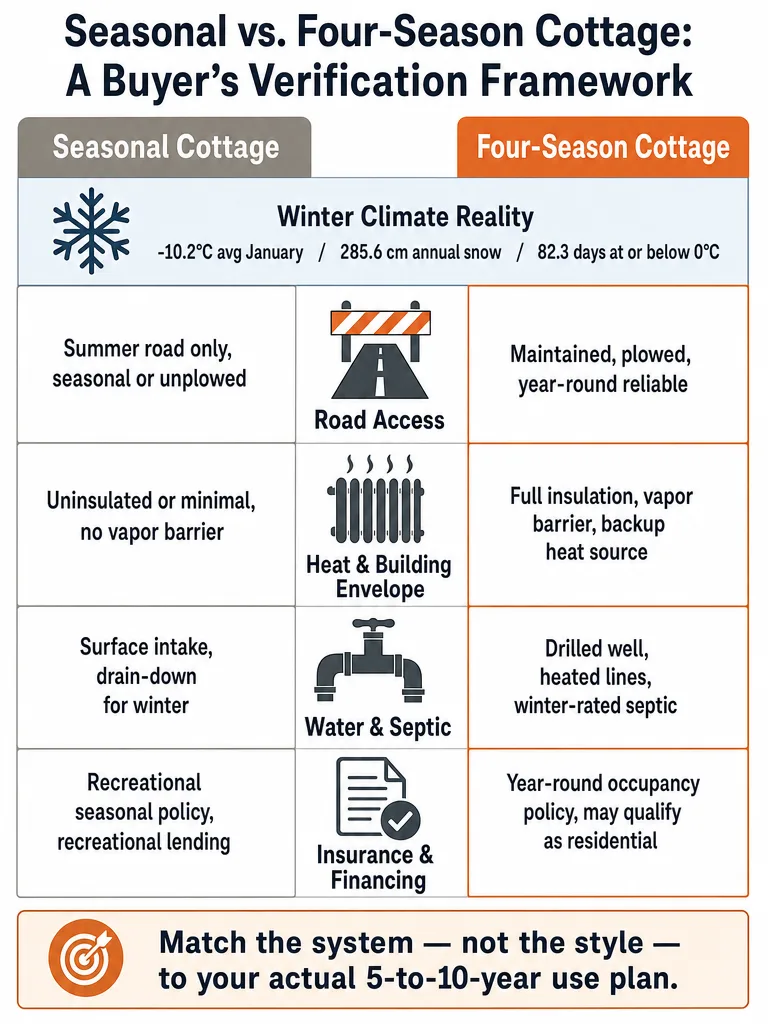
A seasonal cottage is designed for warmer months and was never intended to work as a primary home in winter, while a four-season cottage is built to be occupied, serviced, and insured through freezing weather. The gap shows up in systems, not just insulation. One Muskoka broker describes seasonal properties as having water systems shut down in winter and no permanent heat source.
Here's the practical split, drawn from that same source:
| Feature | Seasonal cottage | Year-round cottage |
|---|---|---|
| Heat | Often no permanent heat source | Reliable heating system |
| Water | Shut down in winter | Heated water lines, drilled well |
| Septic | Not built for winter use | Full system designed for winter use |
| Insulation | Meant for mild temperatures | Proper insulation and vapor barriers |
| Road access | May not be municipally maintained | Maintained access |
| Insurance/financing | Restrictions common | Closer to residential terms |
A year-round cottage functions much closer to a house than a traditional cabin. That's why it carries a higher value: it's a livable residence, not only a recreational property.
The trap is buying a charming place in July and assuming winter visits will be simple. Water must be winterized, pipes can freeze, roads may not be plowed, and insurance may restrict winter occupancy. Knowing which category you're in before the offer saves the expensive surprise after closing.
What makes a Muskoka cottage truly four season?
Four systems have to work together for a Muskoka cottage to earn the four-season label: reliable heat, a tight building envelope, freeze-protected water, winter-capable septic, and access you can count on. Cottage Life Realty frames it plainly: a true four-season cottage is more than a heated building, it's a property that can be occupied, serviced, and insured through winter with the right systems working together.
Start with the envelope, because heat can't do its job in a leaky building. Natural Resources Canada describes the thermal envelope as the basement walls and floor, above-grade walls, roof, windows, and doors. When these underperform, you get drafts, condensation, uneven temperatures, and higher energy bills. CMHC groups the common upgrades around insulation, air sealing, windows, doors, roof, attic, and foundation, and notes insulation and air sealing are often the cost-effective place to start.
Heat comes next. The same source, citing NRCan, says cold-climate electric heat pumps can work well below freezing, down to -30°C, with backup heating for the coldest days. In Muskoka, backup heat isn't optional insurance, it's the plan for a hard cold snap.
Then water and septic. A year-round property typically pairs heated water lines with a drilled well and a septic system built for winter use. Ontario notes that rural cottages may run on-site sewage systems, that owners are responsible for operation and maintenance, and that permits are required to install, alter, extend, or repair those systems. Verify the septic isn't just present, but sized and installed for the winter use you're planning. Our guide to common septic issues in Muskoka cottages covers what to check.
Can you use a Muskoka cottage year-round?
Yes, but only if the systems and access support it, because listing language rarely matches Muskoka winter reality. Environment and Climate Change Canada climate normals for Huntsville, cited by Cottage Life Realty, show an average daily temperature of -10.2°C in January and -8.6°C in February, with 285.6 cm of annual snowfall.
Two more numbers make the point. Huntsville records 54.4 snowfall days and 82.3 days each year when the daytime high never climbs above 0°C. That's roughly a quarter of the year spent at or below freezing. A building that feels cozy in July can reveal hard limits once those conditions set in.
So "year-round" is a property condition, not a marketing claim. A cottage advertised as winterized still needs the heat, envelope, water, septic, and access to actually deliver. Ask for proof: what heats it, what backs that up, how the water and pipes stay above freezing, and whether the road is plowed.
If the answers are vague, treat the property as seasonal until an inspection says otherwise.
Is winter road access required for a Muskoka cottage to be functional year-round?
Reliable winter access is the make-or-break factor for year-round use, and it's the detail listings most often gloss over. A cottage that's a five-minute drive in August can become a real problem in February if the road is private, seasonal, or not regularly plowed. Mark Weiland's team notes that road access and winter maintenance materially affect whether a cottage is practical for winter use.
Confirm these before you write an offer:
- Who plows the road, and how often. Municipal maintenance is different from a private arrangement that depends on neighbours.
- Is there a private-road agreement, and what does it cost each year? Get the terms in writing.
- Can service vehicles reach the property in winter, including septic pump-outs, heating fuel delivery, and emergency access.
- Water-access cottages need a separate plan. If the only route in is by boat, year-round use may not be realistic at all.
Seasonal cottages often sit on roads that aren't municipally maintained, which is fine for a summer getaway and a dealbreaker for winter living. For a deeper look at how this drives price and financing, see what road access adds to Muskoka cottage value.
Are seasonal cottages cheaper than year-round cottages in Muskoka?
Seasonal cottages generally cost less upfront, and one market source puts the year-round premium at 10% to 25%, depending on the property. CV Real Estate reports that the year-round premium in Muskoka typically runs 10% to 25% based on the lake, construction quality, and road and water infrastructure. That figure comes from a single market source, so treat it as a directional estimate rather than a settled market average until a local agent prices comparable properties for you.
That range is wide for a reason. The premium reflects real differences that follow you long after closing, not just a bigger heating bill:
- Lake and construction quality. A well-built year-round home on a premium lake sits at the top of the range.
- Road and water infrastructure. Maintained access plus a drilled well and winter septic add cost, and value.
- Insurance and financing. Year-round properties often qualify for terms closer to a residential home, while seasonal cottages can face restrictions.
- Long-term flexibility. You're paying for the option to use the property in any season, and for a larger resale buyer pool later.
The cheaper seasonal cottage can still be the smarter buy if it matches your use. The mistake is paying the year-round premium for flexibility you'll never touch, or buying seasonal and discovering winter use would cost more to retrofit than the discount saved. For broader budgeting, see what Muskoka cottage prices look like in 2026.
Can a seasonal Muskoka cottage be winterized later?
Sometimes, but budget for a system-by-system upgrade rather than a quick fix, and confirm what's actually possible before you count on it. Turning a three-season cottage into a four-season one usually means addressing the same components that define a year-round property: envelope, heat, water, septic, and access.
Based on how the sources describe four-season requirements, expect to evaluate:
- Insulation and air sealing, since seasonal cottages are often insulated only for mild temperatures.
- Windows and doors, which NRCan flags as common sources of drafts, energy loss, and condensation in older cottages.
- A reliable heating system with backup, given Muskoka's stretch of days at or below freezing.
- Freeze-protected plumbing and a winter-capable water supply, such as heated lines and a drilled well.
- Septic suitability for winter use, which Ontario notes requires permits for installation, alteration, extension, or repair.
- Road access, the one item you often can't fix, because it depends on how the road is maintained.
Specific upgrade cost ranges aren't supported by the available sources, so treat any all-in number with skepticism until a contractor and inspector price your particular cottage. Some seasonal properties convert reasonably; others, especially those with poor access or unsuitable septic, don't make financial sense to retrofit at all.
What buyers need to confirm before buying a year-round cottage in Muskoka
Before you make an offer on a year-round cottage, confirm that heat, envelope, water, septic, access, and insurance all support winter living, not just one or two of them. Mark Weiland's team advises buyers to verify whether the insulation, heating, water supply, plumbing, and septic are suitable for colder temperatures and ongoing winter use, not occasional occupancy.
Run this checklist, and write the important items into your offer conditions:
- Primary heat source and how it's fueled. Confirm it's sized for the coldest weeks.
- Backup heat, since cold-climate heat pumps rely on backup for the deepest cold, down toward -30°C.
- Insulation and vapor barriers throughout walls, ceilings, and floors.
- Air sealing around windows, doors, and penetrations, the cost-effective envelope fix CMHC highlights.
- Water lines that are heated or otherwise freeze-protected, plus a drilled well or winter-capable supply.
- Septic system confirmed suitable and permitted for winter use.
- Roof condition and snow load, including flashing, shingles, and gutters, per the winter maintenance checks Nightscapes recommends.
- Insurance fit, confirming the insurer allows your intended winter occupancy.
- Financing treatment, whether the lender views it as residential or seasonal.
An independent inspection ties these together, which is why a cottage inspection focused on the right factors matters more here than on a summer-only property.
How should lake, town, and access patterns affect the choice?
Match the property type to how each lake and town actually gets used, because access and services differ sharply across Muskoka. Public detail on which specific lakes carry more winterized inventory is limited in the available sources, so treat this as a fit exercise rather than a ranking.
A few practical connections:
- Premium lakes like Lake Joseph and Lake Rosseau draw buyers who want the option of year-round use, which pushes toward true four-season builds.
- Lake Muskoka is a varied market with real differences in shoreline and access, so seasonal and year-round options sit side by side.
- Town choice matters. Bracebridge fits year-round living with walkability and healthcare, while Gravenhurst offers a lower entry point.
- Water-access and off-water tradeoffs change the winter math, covered in our waterfront vs off-water guide.
Start by narrowing the lake and town to how you'll use the place, then apply the winter checks above.
How do insurance, financing, and carrying costs change the decision?
Winter use can change your insurance terms, how a lender classifies the property, and what you spend to keep it running. Mark Weiland's team notes the seasonal-versus-year-round distinction affects insurance, financing, comfort, and maintenance. Concrete insurer names, lender requirements, and cost-line figures like premiums, hydro, snow removal, and road fees aren't supported by the available sources, so get quotes specific to the property before you commit.
Ready to match a lake and property type to how you'll actually use it? Get lake-by-lake buying guidance from Drabinsky Realty.
Frequently asked questions
What is the difference between a seasonal cottage and a four-season cottage in Muskoka?
A seasonal cottage runs on water systems shut down each winter and has no permanent heat source — it's built for spring through fall only. A four-season cottage pairs a reliable heating system with heated water lines, a drilled well, winter-capable septic, proper insulation, and maintained road access. The gap shows up in systems, not just comfort, and it affects insurance and financing terms too.
Can you use a Muskoka cottage year-round?
Yes, but only if heat, water, septic, envelope, and road access all hold up through real Muskoka winters. Huntsville averages -10.2°C in January and -8.6°C in February, with 82.3 days a year when the high never climbs above 0°C, per Environment and Climate Change Canada normals. "Winterized" in a listing means nothing without proof of what heats the building, how pipes stay above freezing, and who plows the road.
Are seasonal cottages cheaper than year-round cottages in Muskoka?
Generally yes — the year-round premium typically runs 10% to 25% depending on the lake, construction quality, and road and water infrastructure, according to CV Real Estate. That gap reflects real differences in systems and resale buyer pool, not just a bigger heating bill. A seasonal cottage can still be the smarter buy if your realistic use pattern is May through Thanksgiving and you won't touch the winter flexibility you'd be paying for.
Is winter road access required for a Muskoka cottage to be functional year-round?
It's the single most important factor — and the one listings most often gloss over. Confirm who plows the road and how often, whether a private-road agreement exists and what it costs annually, and whether service vehicles like septic trucks and fuel deliverers can reach the property in February. Water-access-only cottages may not be realistic for year-round use at all, since the only route in disappears when the lake doesn't freeze safely.
What systems does a Muskoka cottage need to be truly four season?
Five things have to work together: a reliable primary heat source with cold-weather backup (heat pumps can operate down to -30°C but need backup for the deepest cold), a tight building envelope with proper insulation and air sealing, freeze-protected plumbing and a drilled well, a septic system permitted and sized for winter use, and municipally maintained or reliably plowed road access. Miss any one of them and the property functions as seasonal regardless of what the listing says.
Can a seasonal Muskoka cottage be converted to four season later?
Sometimes, but it's a system-by-system project covering insulation, air sealing, windows, a heating system with backup, freeze-protected plumbing, and septic upgrades — each of which requires permits under Ontario rules. Road access is the one item you often can't fix, because it depends on how the municipality or a private agreement maintains the road. Get a contractor and inspector to price your specific cottage before assuming the conversion makes financial sense.
Sources
- Four Season Muskoka Cottage: What to Check Before You Buycottageliferealty.com
- Choosing the Perfect Cottage Rental in Muskokawww.facebook.com
- Winterized beachside cottage rental in Muskokacedargrove.on.ca
- Muskoka Resorts Winterwww.nightscapes.ca
- Cottage Recommendations : r/Muskokaluxurymuskokarealestate.com
- The Ultimate Winter Cottage Guide to Enjoy the Muskoka ...luxurymuskokarealestate.com
- Seasonal vs Year-Round Cottages in Muskoka | What Buyers Need to Knowwww.cottagevacations.com
- Can You Use a Muskoka Cottage Year-Round? What Buyers Need to Confirmwww.reddit.com