What should I check about private road agreements before I make an offer?
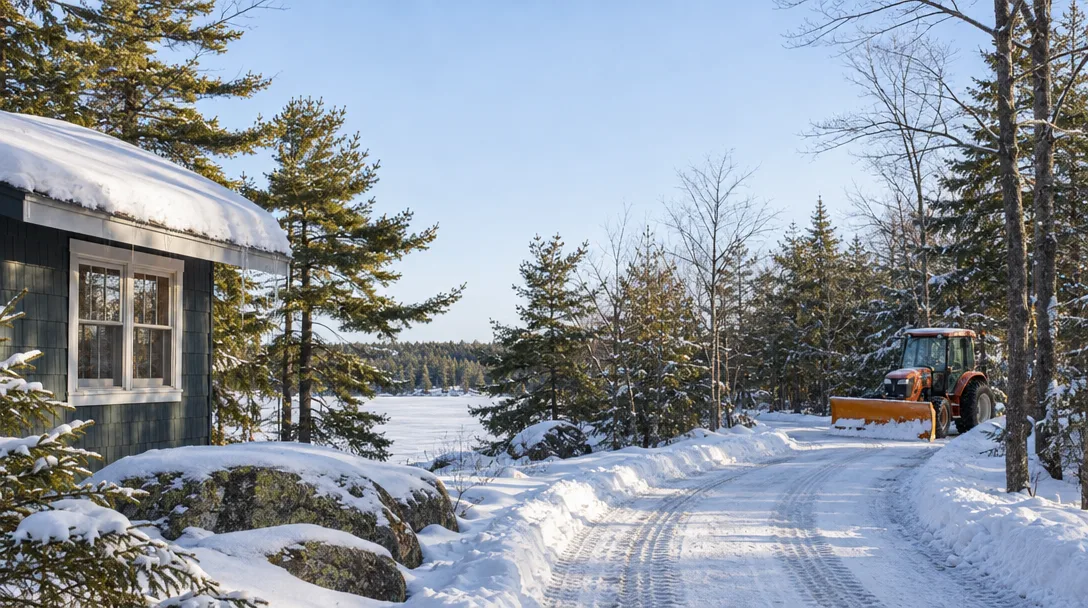
Before a cottage offer, private road agreements should be checked for two separate things: a legal right for your parcel to use the road, and written maintenance and payment terms. If you plan winter use, also look for a written snow-removal duty. Karin Rotem's Ontario pre-offer checklist says to ask for road association documents where one exists.
"Can I drive on it?" and "who keeps it drivable, and who pays?" are two questions with two sets of paper. Rotem frames the first as a choice between a municipal road, a private road with a registered easement, or water access only.
For the second, Kristyn Kennedy's Muskoka due-diligence checklist asks who maintains the road in winter and whether road fees, snow-removal costs or shared maintenance agreements apply. Sharon Wilson's Muskoka and Parry Sound buying guide says private roads depend on neighbor agreements, and that buyers should get them in writing and review them with a lawyer.
What does a winter-use purchase look like on paper? An illustrative example
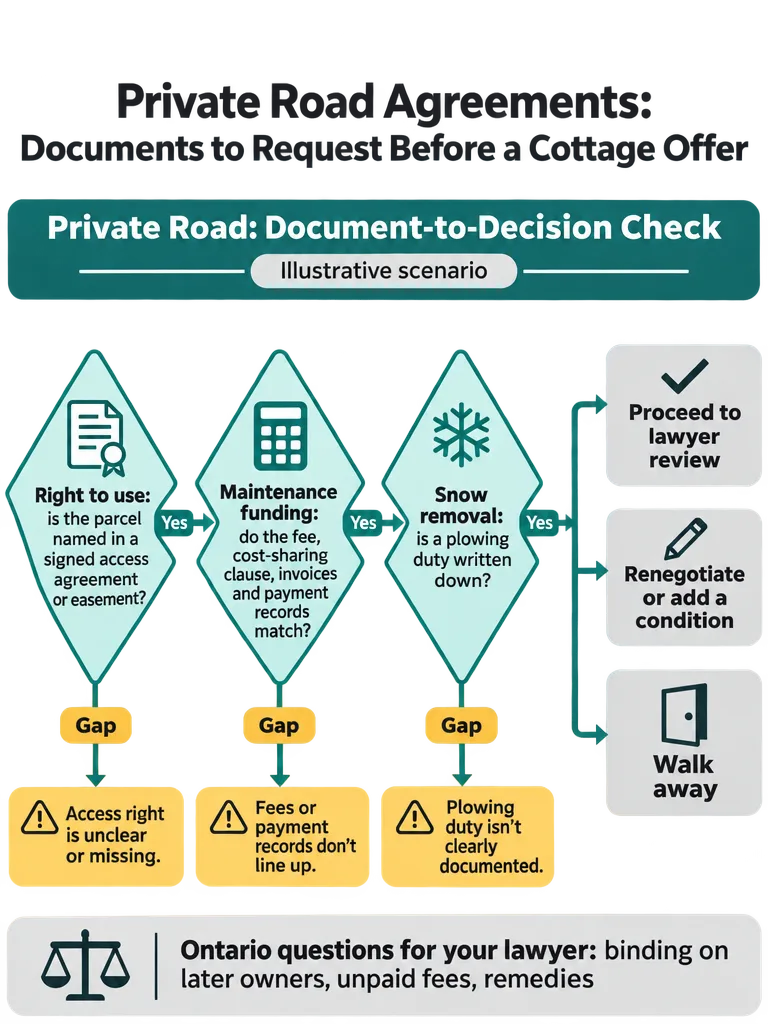
In this illustrative scenario, a winterized cottage has no confirmed written snowplowing arrangement, so winter access stays unverified even though the building is ready for the season. No real property, client, agreement, fee or invoice is described here.
A buyer wants the cottage for February weekends on a Muskoka private road. The listing says "year-round," and the seller says the neighbors "look after the plowing." The buyer asks for two things first: the signed road agreement with its amendments, and whatever shows who plows.
Suppose the agreement covers access and general upkeep, but snow removal appears nowhere in writing. That one gap changes the offer more than a missing fee figure would. The cottage may suit winter use, but who clears the road in January is unconfirmed, and what that means legally is a question for the buyer's lawyer.
From there the buyer has three options:
- Ask the seller for a written plowing arrangement.
- Make the offer conditional on lawyer review of whatever the seller produces.
- Walk away.
The winter-viewing guide on what snow hides and what it reveals at a Muskoka cottage covers the other half: what you can and can't learn by seeing the road under snow.
Which documents prove the right to use the road, and which show who pays to maintain it?
Pender & Coward, a US law firm, notes that maintenance terms can appear in an access easement or in a separate agreement. A sample agreement from Capital Title lists access, utilities, a road manager, cost sharing, snowplowing and future owners as separate provisions. Both are US sources, used here as a document-review framework, not as statements of Ontario rules.
| Document | Question it answers | What a gap means |
|---|---|---|
| Signed agreement and amendments | Maintain and pay: who has agreed to what | Written maintenance and payment duties remain unconfirmed; have the lawyer check the complete document package |
| Access easement or deeded right | Use: does this parcel have a legal right to the road | The right of access is unconfirmed |
| Survey and parcel identification | Use: is your lot the one the documents cover | Whether the agreement covers your parcel and route is unconfirmed |
| Road association documents | Maintain and pay: who manages, decides and collects | It is unclear who holds records or approves work |
| Recent invoices and payment records | Pay: what was actually spent and collected | The stated fee can't be checked against real spending |
Capital Title's sample defines a parcel by its parcel identification number and frontage on the road, which is why the survey matters. Put one question to your lawyer: do the agreement, the access document and the survey identify both the cottage parcel and the route you will actually drive?
For how access affects price, see what road access adds to Muskoka cottage value.
Who plows the road in winter, and where is it written down?
The records that identify who plows a private road are a plowing contract or a written snow-removal clause in the agreement, naming the provider and the agreed winter duties. A seller's verbal "yes, it's plowed" is not one of them. Andrew Bulloch's buymuskoka.com checklist says to ask whether the road is plowed, who maintains it, and what the association fees are.
Work through it in order:
- Ask who plows. Get a name: a contractor, an association, a municipality or a neighbor.
- Ask for the signed contract or the agreement clause that defines the service. Invoices are separate evidence. They show work was done and paid for, not that anyone owes continuing service. Association minutes are records to investigate, and your lawyer should say whether any of them creates a binding duty.
- Check whether the actual agreement addresses snowplowing at all. Capital Title's sample has a separate snowplowing clause requiring year-round access, with costs shared like other maintenance. Don't assume yours has one.
- Separate the building from the road. A winterized cottage tells you about the cottage, not whether you can reach it in January. Bulloch adds that some Muskoka properties are inaccessible from November to April.
Lakelands Real Estate reports that Muskoka Lakes says private roads and lanes need winter maintenance for emergency access. That is a secondary-source summary. The research here doesn't confirm current municipal winter-maintenance or emergency-access rules for any specific road, so verify the road's status with the municipality.
How do I check the seller's stated road fee against the agreement and the invoices?
Check the fee by lining up four things: what the seller says, what the agreement's cost-sharing clause says, what invoices show was spent, and what payment records show was collected. No typical Muskoka fee or benchmark is given here, because the research doesn't support one. The test is whether the seller's number reconciles with the paper.
Build a simple worksheet:
- Seller's stated fee: the amount, who it is paid to, and how often.
- Cost-sharing clause: copy the allocation formula exactly as the agreement words it. Capital Title's sample shares maintenance, snowplowing and improvement costs pro-rata among the parcels sharing access, and has each owner prepay an estimated annual share to a road account.
- Actual invoices: plowing, grading and repairs for the last few years.
- Payment records: did every owner pay, including the seller?
- Larger repairs: who approves them, and who sets each owner's share?
On approvals, Capital Title's sample requires a majority vote of parcel owners for road improvements. An owner who does unapproved work becomes liable for the whole cost unless it's an emergency. The sample also has a road manager who keeps a bank account and issues an annual income and expense report. Pender & Coward warns that equal cost sharing alone doesn't say how costs are determined or who determines them.
If the numbers don't reconcile, ask the seller for the missing invoices or the association's year-end statement. If no one can explain the gap, tell your lawyer before conditions come off.
What happens if an owner doesn't pay, or the seller only offers a verbal arrangement?
Whether an unpaid share or a verbal arrangement can be enforced for or against you depends on the actual agreement and Ontario law, and the supplied sources contain no verified Ontario guidance on either. Pender & Coward, a US firm, notes that an equal-cost clause doesn't explain how costs are set, who sets them, or what happens on nonpayment.
Put these questions to your lawyer:
- Do the maintenance obligations bind later owners, including you?
- What effect does registration have, if any?
- What happens to unpaid fees, and can they follow the property?
- What remedies exist against an owner who won't contribute?
For contrast, Capital Title's sample lets a majority of owners enforce the agreement. It gives reasonable attorney fees and costs to the party that starts a lawsuit, if that party prevails, and sends disputes to an arbitrator. A real Muskoka agreement may say none of that.
A verbal arrangement leaves you nothing to review. Rotem makes a related point about docks: a verbal understanding with a past owner doesn't transfer with the deed. Ask for the written agreement before you commit. If the seller can't or won't provide one, renegotiating the price or terms, or walking away, are the options on the table.
What should my lawyer, lender and insurance broker see before I commit?
Give your lawyer, lender and insurance broker the road documents from the table above, plus your intended seasonal use. Each reviews a different question. Kennedy's checklist says to confirm you can insure the property before removing conditions, and that year-round access can affect premiums. Wilson's guide says some lenders have specific rules for properties without year-round access.
- Lawyer: the full package, the nonpayment and later-owner questions above, and a written account of any verbal promises. Ask which gaps should become offer conditions.
- Lender: the access documents and whether you plan weekends, full-time or summer-only use.
- Insurance broker: the same use plan and the facts about winter road access.
Lender and insurer requirements and offer-condition wording aren't confirmed in the research for any particular property, so your lawyer should draft the conditions. For the full buying sequence, see how to buy a cottage in Muskoka without costly mistakes.
Seth Drabinsky is a Real Estate Salesperson with CV Real Estate, Brokerage, who lives in Muskoka year-round and works with buyers and sellers across Lake Muskoka, Lake Rosseau, Lake Joseph and Lake of Bays.
Frequently asked questions
How are private road maintenance costs split between cottage owners?
The agreement sets the split, and it varies. A US sample from Capital Title shares maintenance, snowplowing and improvement costs pro-rata among the parcels using the road, with each owner prepaying an estimated annual share. Another checklist lists per lot, per use or by frontage as ways to divide costs. Read the cost-sharing clause word for word, and check who decides the amounts.
What clauses should a private road agreement include?
A useful agreement covers use, upkeep and money in separate clauses. A US sample from Capital Title includes an access easement, a utility easement, an elected road manager, majority-vote approval of improvements, cost sharing that includes snowplowing, and annual prepayment into a road account. Treat it as a review framework, not an Ontario rule, and have a lawyer compare the actual agreement against it.
How do I confirm a private road agreement exists and covers my cottage?
Ask the seller for the signed agreement with every amendment, then have your lawyer review title and the survey against it. Karin Rotem's Ontario pre-offer checklist says to confirm whether access is a municipal road, a private road with a registered easement, or water access only, and to request road association documents where one exists. A verbal assurance leaves nothing to check.
If a cottage is winterized, can I assume the private road is plowed?
No. A winterized building says nothing about whether the road is cleared in January. Andrew Bulloch notes some Muskoka properties are inaccessible from November to April, and Sharon Wilson says private roads depend on neighbor agreements. Ask who plows, get the contract or agreement clause in writing, and treat winter access as unconfirmed until you have it.
Does a cottage on a private road in Muskoka Lakes need a 911 address?
Yes. Lakelands Real Estate reports that Muskoka Lakes requires a 911 address for all properties, and that changes to a private road's structure or entrances should be reported so civic addressing stays accurate. The same summary says private roads need winter maintenance for emergency access. It is a secondary source, so confirm the property's address and road status with the municipality.
Can I make my cottage offer conditional on the private road documents?
A buyer can ask for the offer to be conditional on a lawyer's review of whatever road documents the seller produces. That is one of three options when a plowing arrangement is missing, alongside asking for it in writing or walking away. Karin Rotem advises running pre-offer checks before writing the offer, not after, and a lawyer should draft the condition wording.
Sources
- karinrotem.comkarinrotem.com
- www.kristynkennedy.comwww.kristynkennedy.com
- sharonwilsonrealestate.comsharonwilsonrealestate.com
- Private Road Maintenance Agreementcapitaltitle.net
- buymuskoka.combuymuskoka.com
- lakelandsrealestate.calakelandsrealestate.ca