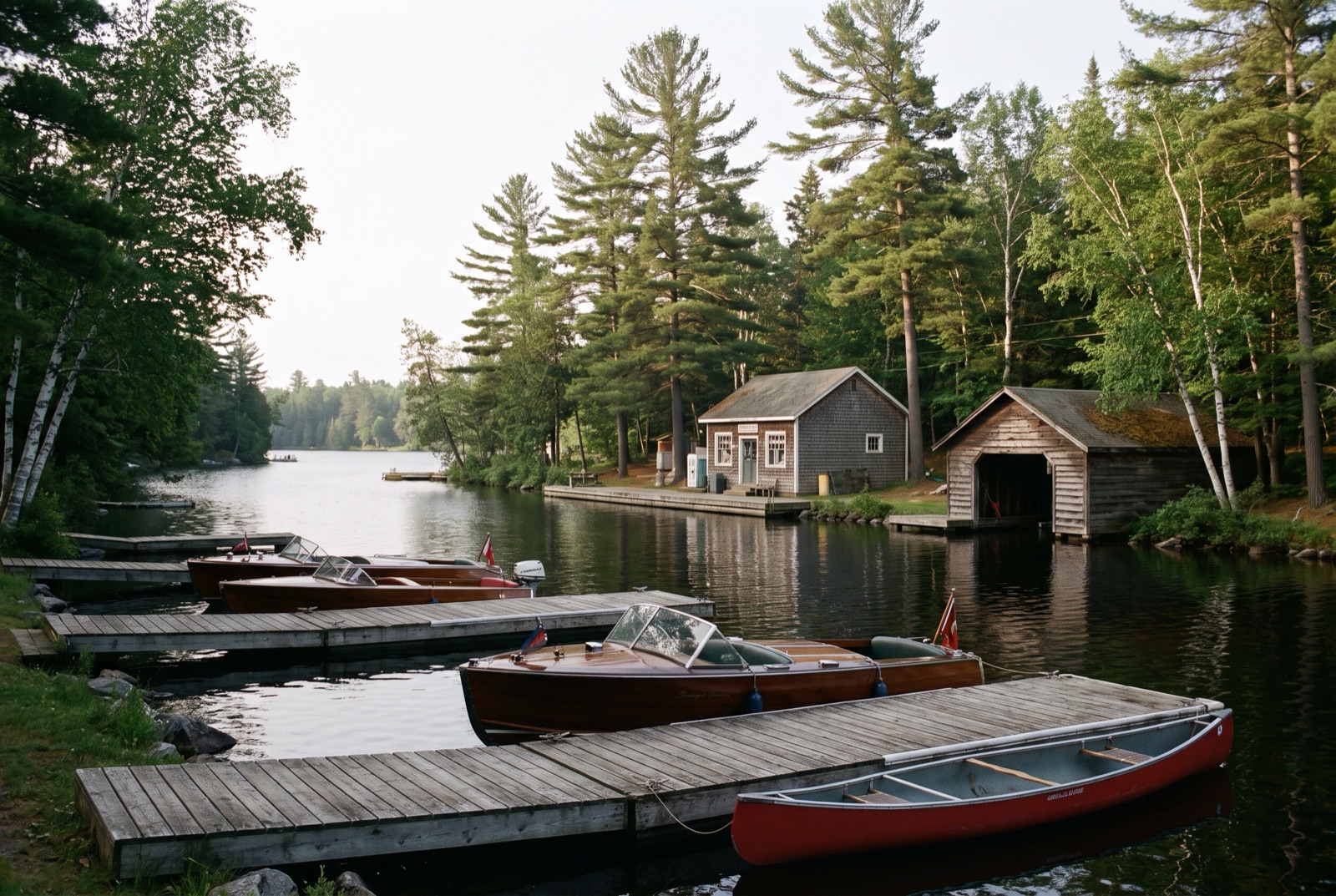
Why is Port Carling called the Hub of the Lakes?
Port Carling earns the "Hub of the Lakes" name because it sits between Lake Muskoka and Lake Rosseau and opens onward access to Lake Joseph through the historic Port Carling locks (Source: Neil & Cat Brown). That central position is exactly why CV Real Estate ties the community's appeal to boating access across Muskoka's Big Three lakes.
For a buyer, this isn't trivia. It's the functional reason a waterfront here can be worth more. If you own a boat and want to reach Lake Muskoka, Lake Rosseau, and Lake Joseph in a single outing, the locks make that practical from a Port Carling base. Few Muskoka locations connect all three the way this village does.
The hub matters most to buyers who will actually run the boating corridor, not to those who rarely leave their own bay. If your weekends are mostly dock-and-swim, the connectivity is a nice-to-have rather than a reason to pay up. Be clear with yourself about which one you are.
What kind of real estate is available in Port Carling?
Port Carling real estate spans four broad categories: in-village homes, commercial spaces, waterfront estates on Lake Muskoka and Lake Rosseau, and channel-area properties between the two lakes (Source: CV Real Estate). That mix is wider than many small Muskoka communities offer, which is part of the draw.
One caveat shapes every search. Available options here may be more limited than in surrounding towns, according to local listing coverage. Scarce shoreline is exactly what CV Real Estate credits for the premium, so the inventory you want may not always be on the market when you start looking.
A quick way to frame the categories:
- In-village homes — closest to shops, marinas, and dining; good for buyers who want walkability over seclusion.
- Channel-area properties — near the locks, with direct connection to both Lake Muskoka and Lake Rosseau.
- Waterfront estates — the luxury core, on Lake Muskoka and Lake Rosseau.
- Commercial spaces — relevant for buyers eyeing village business or mixed use.
How much do Port Carling luxury properties cost?
Port Carling luxury properties commonly exceed $3 million, and legacy waterfront estates reach well above $10 million (Source: CV Real Estate). The luxury segment dominates this market, so a buyer expecting entry-level Muskoka pricing should reset expectations before touring.
Beyond those two anchors, the public sources stay quiet. There's no defensible price-per-foot figure for Port Carling and no recent sold-price data in the corpus that would let anyone pin down a precise "village-access premium." So treat the numbers below as the supported brackets, not a full price ladder.
| Segment | Indicative price | Source |
|---|---|---|
| Luxury properties (common) | Over $3 million | CV Real Estate |
| Legacy waterfront estates | Well above $10 million | CV Real Estate |
That range is the supported ceiling and floor for the luxury tier. Use it to gut-check any listing before you let the view do the talking.
Should I buy close to Port Carling village or in a quieter area?
Buying close to Port Carling village suits buyers who want walkable access to shops, restaurants, marinas, and summer waterfront energy; a quieter area suits those who value privacy and forest seclusion more. Local buyer guidance frames this as the central trade-off in Port Carling, and Neil & Cat Brown describe the village as a vibrant, walkable downtown core during summer.
This is a daily-use decision, not an aesthetic one. In July, the village hums with shops, dining, and marina activity. If you picture short walks to dinner and easy boat access, near-village earns its premium. If you picture early-morning quiet and no neighbors in sight, a forest setting farther out may serve you better for less.
| Priority | Lean near village | Lean quieter setting |
|---|---|---|
| Summer social energy | Yes | No |
| Walkable amenities | Yes | No |
| Privacy and seclusion | No | Yes |
| Likely entry cost | Higher | Often lower |
| Boating convenience | Strong | Varies by site |
Bryan Coxworth's Port Carling lifestyle guide covers village amenities and lake living for buyers weighing the same question.
Does waterfront quality matter when buying in Port Carling?
Waterfront quality matters more than the address in Port Carling, because the premium should track usable shoreline, not just a prestigious lake name. Local buyer guidance stresses matching shoreline features to intended use: sandy, gradual beach for swimming and kids, deeper water for boating and fishing. The Egan Team notes premium Lake Muskoka estates with extensive frontage and deep-water access, which signals how much shoreline type drives value.
Walk the shoreline before you fall for the view. Two waterfronts on the same lake can serve completely different families.
- Swimming-first families — want a sandy, gradual entry and protected water.
- Boaters — want deeper water at the dock and reliable access to the corridor.
- Anglers — want depth and structure near shore.
- Everyone — should check dock condition, exposure, and how wind hits the bay.
A high price on poor shoreline for your use is the most common way buyers overpay in cottage country. The grand listing photo rarely tells you whether the water at the dock is two feet deep or twenty, so test the shoreline against your actual plans rather than the brochure's.
Is road access important for a Port Carling cottage?
Road access and maintenance are core due-diligence factors for a Port Carling cottage, especially if you plan winter use. Local buyer guidance flags that some roads are seasonal or less maintained, which can affect year-round access. On the broader travel side, the Egan Team notes Highway 11 provides access to Port Carling from Toronto in 2.75 hours.
The highway gets you to the region quickly; the last stretch to your door is what actually decides winter livability. A property can sit two hours from Toronto and still be impractical in February if the private road isn't plowed.
Ask three things before you commit:
- Is the road public, private, or shared, and who maintains it?
- Is it plowed all winter, or does maintenance stop after the season?
- If it's a shared road, what does each owner pay and what's the agreement?
For winter buyers especially, these answers shape whether the property is a four-season home or a summer-only one.
What should I look for when buying a cottage in Port Carling?
When buying a cottage in Port Carling, run every property through one decision test: does it match how you'll actually use the place, across boating, village access, shoreline, road reliability, and budget? The sources support seven concrete checks that turn lifestyle appeal into functional criteria.
Use this on every tour:
- Village proximity — close enough for the walkable access you want, or quiet enough for the privacy you want?
- Big Three boating access — will you actually run the corridor to Lake Muskoka, Lake Rosseau, and Lake Joseph through the locks?
- Shoreline fit — sandy beach for swimming, or deeper water for boating and fishing?
- Road maintenance — is it plowed and serviceable for your intended season of use?
- Realistic budget — does it hold up where many luxury properties exceed $3 million?
- Limited inventory — are you ready to act when the right scarce property appears?
- Use pattern — does the property support your real weekends, not the brochure's?
Port Carling vs Lake Muskoka, Lake Rosseau, and Lake Joseph searches
Port Carling works best as a central access point rather than a separate market, since the village connects Lake Muskoka and Lake Rosseau directly and reaches Lake Joseph through the locks (Source: Neil & Cat Brown). If inventory here is too thin for your timeline, widening to the lakes themselves often opens more options while keeping the corridor advantage.
Think of it as searching the hub versus searching the spokes:
- Port Carling-centered — best for walkable village access plus boating connectivity in one purchase.
- Lake Muskoka — the largest, most varied market in the Big Three.
- Lake Rosseau — the prestige lake, with strong demand for established estates.
- Lake Joseph — premium privacy, typically the upper end of the price range.
If inventory or budget pushes you to widen the search, the corridor advantage still travels with you: a property on any of the three lakes can reach the others, so the central-access logic that makes Port Carling attractive doesn't disappear the moment you move off the village's doorstep.
Sources
- Jeffrey Braun on Instagram: " Buying a cottage? Don't just fall for ...www.instagram.com
- Port Carling: Muskoka Luxury Real Estate Hubcvrealestate.com
- Port Carling Real Estate Lifestyle & Village Guidecottageliferealty.com
- do you believe in paying premiums for views, waterfront, etc? - Redditwww.reddit.com
- Port Carling Real Estate - Homes for Sale | Egan Teamwww.patrickegan.com
- Port Carling Cottages For Sale | The Aben Teammuskoka-realestate.ca
- What to Look for When Buying a Cottage in Port Carling: Your Ultima...laurainmuskoka.com
- Port Carling | Waterfront & Community Guide -neilbrownmuskoka.com