What should I check if a Muskoka cottage has a shoreline road allowance?
A Muskoka cottage with a shoreline road allowance may not include the shoreline. If an allowance exists, even only on paper, you won't own to the water's edge unless title to it has been purchased, according to Bracebridge Realty. Your lawyer should confirm what the seller owns, where the improvements sit, and which municipality's rules apply.
A shore road allowance is a strip, historically 66 feet wide, that Crown surveyors laid out along lake and river banks between the cottage lot and the water. Bracebridge Realty notes that the dock, boathouse or even the cottage can sit on it, and that the strip can be freely enjoyed by members of the public.
Start with these three questions:
- Does the seller's title include the strip, or only a promise to buy it?
- Does the survey place the dock, boathouse or stairs on the lot or on the allowance?
- Does the municipality's current policy let the next owner build or rebuild what you want?
Is the shoreline allowance the seller's, or only approved for purchase?
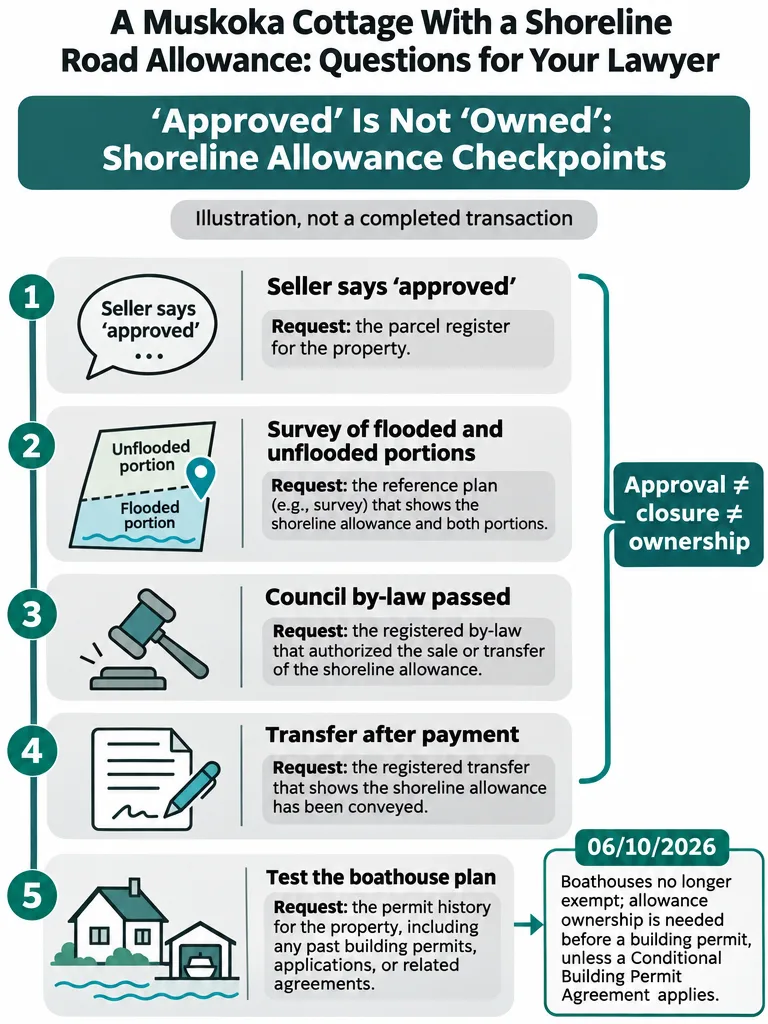
An allowance belongs to the seller only after the transfer is completed. Approval is an earlier step. The Town of Huntsville's published process runs in this order: application approval, a survey identifying flooded and unflooded portions, closing and purchase steps handled by the Town's solicitor, a Council by-law, and transfer after the purchase price is paid.
Illustration, not a completed transaction. Picture a cottage in Huntsville where the listing says the shore road allowance is "approved." Here is what the lawyer should ask to see at each stage:
- The approval. Ask for the Town's approval of the closure application and the file behind it. Huntsville says staff can approve when abutting neighbors give approval letters. Otherwise the file goes to the Development Services Committee. Find out which route this was.
- The survey. Ask for the reference plan and check that its parcel matches the strip the seller says they are buying.
- The closing steps. Ask whether the Town's solicitor has completed them and whether the seller has paid the purchase price.
- The by-law. Ask for the registered Council by-law.
- The transfer. Ask for the registered transfer and a current parcel register showing the strip in the seller's title.
Language also varies. A Muskoka real estate blog at callkim.ca separates open, closed and conveyed allowances, while other guides use "closed" loosely. A closed allowance is not the same as a conveyed one, so ask whether the identified parcel was actually conveyed to the seller.
Some brokerage guides describe the strip as Crown land and others as municipal land. The municipal pages supplied for this article do not establish a general Crown rule, so the lawyer should verify who holds title to the actual parcel.
Does the survey put the dock, boathouse or stairs on the seller's land or on the allowance?
Ask for a current survey and read where every shoreline structure sits relative to the lot lines. Huntsville requires a scaled sketch or site plan that locates and measures existing and proposed structures or encroachments, on both the applicant's property and Town property, including distances to the lot lines and the shoreline.
The Township of Muskoka Lakes lists boathouses, stairs, railings, gazebos and retaining walls as shoreline structures that need a building permit and can be affected when the owner does not own the allowance. Check each one on your survey.
If something sits on the allowance, the options depend on the municipality. Lakelands Real Estate says a Huntsville dock or boathouse may require the allowance to be purchased or used under a license of occupation. Ask the lawyer whether either route is available for this parcel in this municipality. Separately, check the permits and legal status of each existing structure, because neither route is shown to settle that on its own.
Ask the seller for the permit or license paperwork for every structure. For what to look at on a showing before the survey arrives, see how to evaluate shoreline quality on a Muskoka cottage.
How does Muskoka Lakes' 06/10/2026 boathouse rule change the purchase and permit order?
The Township of Muskoka Lakes says in its 07/17/2026 notice that boathouses ceased to be exempt from its Original Shore Road Allowance (OSRA) requirements on 06/10/2026. Allowance ownership is required before a boathouse building permit is issued, except that eligible owners may enter a Conditional Building Permit Agreement after initial purchase approval.
Council approved the change that day to the Township's Sale of Shore Road Allowances and Road Allowances Policy. Under the conditional option, the building permit process can advance while the purchase is completed.
Buying the allowance does not finish the job. The Township separately identifies dock permits, building permits, and possible provincial and federal approvals, including the Ministry of Natural Resources, the Department of Fisheries and Oceans, the Navigation Protection Program and Parks Canada.
The supplied material does not give the full policy text, eligibility criteria, security requirements or what happens to an agreement when the property sells. Put these to the Township and the lawyer:
- Is the planned boathouse eligible for a conditional permit?
- What security or obligations come with the agreement?
- Does the agreement pass to a buyer, or must it be redone?
For lot-level fit beyond the paperwork, see what makes a good waterfront lot in Muskoka.
What does buying a shore road allowance cost, and which numbers are dated?
Buying an allowance involves application fees, land charges, survey costs, municipal and buyer legal costs, and possibly other approvals. The only municipal figures in the research are Huntsville's: a $1,187 application fee, 2025 land rates of $13 to $17 per square meter, and a $2,650 legal-fee deposit. None is confirmed as a current 2026 amount, and none applies outside Huntsville.
The worksheet below follows Huntsville's closure application page.
| Cost item | What the research supports | Caveat |
|---|---|---|
| Application fee | $1,187 (Town of Huntsville) | Huntsville says fees are updated annually; not confirmed as the fee in force on 11/19/2026 |
| Land price | $17 per square meter, Huntsville's general OSRA closing rate | Labeled 2025 |
| Land price, one river stretch | $13 per square meter, Huntsville's rate for the Muskoka River between Port Sydney Dam and Stephenson Road 1 East (Huntsville application page) | Labeled 2025; not a lake rate |
| Legal-fee recovery deposit | $2,650 (Town of Huntsville, application page) | Unused portion returned after file closure; year not stated |
| Survey | Arranged and paid by the applicant (Huntsville) | No amount in the supplied sources |
| Buyer's legal fees | Not quantified in the sources | Ask your lawyer |
| Additional approvals | Dock, building and agency approvals may apply (Muskoka Lakes notice) | Varies by project |
Huntsville lists a separate 2025 price of $11 per square meter, or an applicant-funded appraisal, whichever is less, for closing other highways such as Original Road Allowances. That is a different category and should not be used to price a shoreline strip.
No verified 2026 Muskoka Lakes land prices, total costs or current processing times were found in the research. Get current figures from the municipality in writing before you finalize your budget.
What changes if the cottage is in Huntsville instead of Muskoka Lakes?
Huntsville runs a closure-to-transfer process: the abutting owner applies to close the allowance, and ownership passes after a Council by-law and payment. Muskoka Lakes ties boathouse building permits to allowance ownership, with a conditional-permit option for eligible projects after initial purchase approval. Identify the municipality before relying on any guide.
Lakelands Real Estate notes that two cottages on the same lake may not be reviewed the same way if they fall under different local rules.
| Huntsville | Muskoka Lakes | |
|---|---|---|
| Who applies | The abutting owner applies to close the allowance | Owners who do not own the OSRA and plan boathouse or shoreline work |
| Trigger | Waterfront owners seeking development must purchase the allowance as a condition of planning approval | Boathouses no longer exempt from OSRA requirements since 06/10/2026 |
| Documents | Registered transfer or deed, location map, reasons for closure, agent authorization if applicable | Not detailed in the supplied sources |
| Review | Neighbors contacted; staff approve with abutting neighbors' letters, otherwise the Development Services Committee decides | Conditional Building Permit Agreement possible for eligible projects after initial approval |
Bracebridge, Gravenhurst, Lake of Bays and Georgian Bay requirements are not covered in the research here. Check them with that municipality, and do not extend one municipality's procedure to another.
What should I ask my lawyer before removing conditions on a cottage with a shoreline allowance?
Before conditions come off, the lawyer should review the title and parcel register for the shoreline strip, the registered by-law and transfer, the survey or reference plan locating each shoreline structure, the permit history, any license or encroachment agreement, and any unfinished application. Those records show whether the seller owns the allowance or only holds an application.
This article is general information from a real estate brokerage, not legal advice. Treat the list below as questions for your lawyer.
- Title and parcel register: Does the seller's title include the strip, or only the lot?
- Registered by-law and transfer: If the seller says the allowance was purchased, where are these?
- Survey or reference plan: Where do the dock, boathouse, stairs and retaining wall sit?
- Permit and approval history: What permits exist for each shoreline structure?
- License or encroachment agreement: Is there one, and what are its terms?
- Municipal confirmation: What are the current fees and the status of any application?
Some findings should change your decision:
- The allowance is unfinished. Approval without a registered transfer means the seller does not yet own it.
- A structure sits on the allowance. Ask whether a license or purchase covers it.
- You plan a boathouse. Confirm with Muskoka Lakes whether your project is eligible for a conditional permit.
Ask whether the purchase agreement should address who completes an unfinished purchase and who pays. Also ask your lender and title insurer how they treat an unresolved allowance, since the research does not cover either. For the wider checklist, see how to buy a cottage in Muskoka without costly mistakes.
Seth Drabinsky is a Real Estate Salesperson with CV Real Estate, Brokerage, who lives in Muskoka year-round.
Frequently asked questions
What is a shore road allowance on a Muskoka cottage?
A shore road allowance is a strip of land, historically 66 feet wide, that Crown surveyors laid out along lake and river banks in the late 19th century. It sits between the cottage lot and the water. Most are no longer used as roads, but they still exist legally and can decide who owns the shoreline.
Do I own to the water's edge if there is a shore road allowance?
No, not unless title to the allowance has been purchased. Even an allowance that exists only on paper means the lot does not reach the water's edge without it. Bracebridge Realty adds that the strip can be freely enjoyed by the public, so confirm what the seller's title actually includes.
How do I know if the seller actually owns the shore road allowance?
Ask your lawyer to check the parcel register for the strip, plus the registered Council by-law and transfer. Approval of an application is not ownership. In Huntsville, ownership passes only after a survey, closing steps, a Council by-law and payment of the purchase price. A closed allowance is not always a conveyed one, so confirm the parcel was transferred.
Is a dock or boathouse on a shore road allowance legal?
Bracebridge Realty says that unless the cottager buys the allowance from the municipality or signs a license agreement, structures built on it are effectively illegal. In Huntsville, a dock or boathouse may require the allowance to be purchased or used under a license of occupation. A current survey shows whether each structure sits on the lot or the allowance.
How much does a license of occupation for a shore road allowance cost?
One brokerage source, Bracebridge Realty, puts a license of occupation at $500 to $1,000 a year. It says the license may be terminated at any time and does not prevent public access to the shoreline. No current municipal source confirms that fee, so get the amount and the termination terms in writing from the municipality.
Can I buy a shore road allowance, and how long does it take?
Sometimes, depending on the municipality. Some areas are designated areas of retention where the land is not for sale. Bracebridge Realty says the full process can take six months to a year and involves a survey, application and legal fees. Huntsville's general 2025 rate was $17 per square meter, so confirm current figures with the municipality.
Sources
- Shore Road Allowance, What is it? - Bracebridge Realtybracebridgerealty.ca
- lakelandsrealestate.calakelandsrealestate.ca